
By: Fatima Pouresmaeil
independent journalism
july 6,2025

In the aftermath of the 12-day war between Iran and Israel—a conflict marked by heavy casualties, fiery rhetoric, and threats of retaliation—something darker has unfolded inside Iran. While the regime in Tehran projects defiance to the world, at home it has launched an aggressive campaign of repression.
Dozens have been arrested, and at least several executions have already taken place. The official charges? “Collaboration with Israel,” “espionage,” “anti-regime propaganda.” But these vague accusations hide the truth: the Islamic Republic is once again using chaos as cover to silence dissent and eliminate opposition.
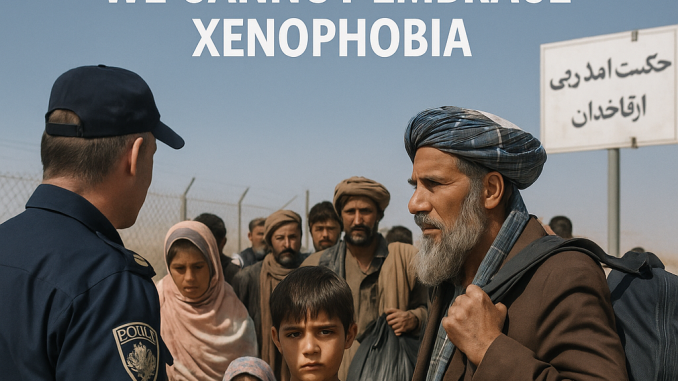
Yet another tragedy is unfolding simultaneously on Iran’s eastern border: the mass deportation of more than 114,000 Afghan refugees—many of them women and children—who had fled the Taliban and sought shelter in Iran. Reports tell of cruel treatment, families torn apart, and people left with nothing but the dust under their feet.
These actions have raised serious concerns, not only about the regime’s human rights abuses, but also about how everyday Iranians, inside and outside the country, view and treat Afghan refugees. A wave of xenophobic rhetoric, social media mockery, and casual racism has emerged—and it must be addressed.
Because if we, the Iranian diaspora and people of conscience, do not stand against this injustice, then what have we learned from our own suffering?
The New Wave of Executions: Silencing Dissent in the Shadows
As the military confrontation between Iran and Israel grabbed headlines, the Islamic Republic wasted no time shifting its focus inward. Under the guise of national security, it began detaining political activists, journalists, students, and even citizens accused of nothing more than social media posts.
Many of these arrests have been followed by hasty, closed-door trials where the accused are denied lawyers and due process. Charges such as “corruption on earth,” “collaboration with enemy intelligence,” and “disturbing national unity” have been used to justify death sentences.
Executions have already begun — carried out in the dark of night, with families informed only after the fact. Some of those executed had previously been active in the Woman, Life, Freedom protests or had participated in civil disobedience campaigns.
This is not justice. It is vengeance.
The regime is desperate to show strength after international embarrassment, and it is using the bodies of its own citizens as proof. It believes that fear will control the streets. But history has shown us otherwise.
The Forced Eviction of Afghan Refugees: A Humanitarian Crisis
At the same time, Iran’s eastern border has become the stage for another horror: the mass deportation of Afghan refugees. According to independent reports and NGOs, more than 114,000 Afghans have been forcibly returned to Afghanistan in just the past few weeks.
These are not criminals. These are families — some who had lived in Iran for years, others who fled the Taliban in recent months. They came seeking safety. What they found was humiliation.
Witnesses describe violent raids, people thrown onto buses in the middle of the night, and refugees denied access to food, medicine, and even their personal belongings. Many were separated from family members, including children taken away from parents.
And while the Islamic Republic justifies these actions as part of a security crackdown, they are, in truth, nothing but a political show of force. Afghans are being used as scapegoats—easy targets in a country where internal problems demand distraction.
The Role of Ordinary Iranians: Complicity Through Silence or Mockery
What’s most heartbreaking is not just what the government is doing — it’s how some segments of Iranian society are reacting. On Persian-language social media, xenophobic jokes about Afghan refugees have spread like wildfire. Phrases like:
“They’re stealing our jobs.”
“They’re all Taliban anyway.”
“Send them back.”
This kind of rhetoric is painfully ironic coming from a people who themselves have been victims of exile, discrimination, and exile. Millions of Iranians fled the Islamic Republic over the last four decades and were met with suspicion, racism, and bureaucracy abroad. We know what it feels like to be called a threat, to be told we don’t belong.
How, then, can we turn around and do the same to Afghan refugees?
We must never forget: seeking asylum is not a crime. It is a right.
And many of these Afghan refugees are Persian-speaking, culturally close to us, and, like us, victims of extremism, war, and oppression. The only difference is which side of the border they were born on.
A Call to Conscience: We Must Stand Up for All Victims of Tyranny
As Iranians, we have every reason to despise the regime in Tehran. Its brutality has affected us all. But we must not let our pain turn into prejudice. We must not let the Islamic Republic’s hate become our own.
Let us be clear: we can oppose the regime without embracing its racism.
We can mourn our martyrs without mocking others.
We can be victims — and still choose compassion.
Whether the victim is a student hanged in Evin Prison or an Afghan child pushed across the border without food, the source of their suffering is the same: a system built on violence, fear, and division.
In Conclusion: Who Are We Becoming?
After the war, after the executions, after the deportations — what remains is a question:
Who are we becoming as a people?
If we allow hatred to enter our hearts, if we adopt the language of exclusion, if we turn our backs on those fleeing the same terror we once fled — then we are no longer the victims. We are part of the problem.
Let us rise above it. Let us use our voices, our platforms, and our votes to protect the vulnerable. Let us speak up — in Farsi, in English, in Dari, in silence, or in protest — against all forms of cruelty.
Let this be our message:
🕊️ We stand with the innocent.
🕊️ We reject xenophobia.
🕊️ And we believe in a future where no one is punished for seeking refuge.