
By: Fatmeh Pouresmaeil
Did an Ancient Biblical Text Foretell a Great War in the Middle East?
Among the many ancient religious texts that humanity has preserved through the centuries, few have generated as much fascination and debate as the prophetic books of the Bible. Written thousands of years ago, some of these texts describe visions of future conflicts, shifting empires, and dramatic transformations among nations.
One of the most intriguing of these prophecies appears in the Book of Ezekiel, a text written more than 2,500 years ago. In its later chapters, the prophet describes a massive alliance of nations that would one day rise in a dramatic confrontation in the region surrounding Israel.
What has captured the attention of many readers and scholars is that among the nations mentioned in this prophecy is “Persia.”
For historians and theologians alike, this reference is significant because Persia is the historical name of modern-day Iran. As a result, the passage has long been the subject of debate among scholars, religious thinkers, and political commentators.
Was Ezekiel simply describing the political realities of his time?
Or could this ancient prophecy be pointing toward future events that would shape the destiny of the Middle East?
Ezekiel: A Prophet in an Age of Crisis
The prophet Ezekiel lived during one of the most turbulent periods in ancient Jewish history. Around the 6th century BCE, the Kingdom of Judah had fallen to the Babylonian Empire, and many of its people were taken into exile.
Ezekiel himself was among those deported to Babylon.
During this period of national despair and uncertainty, Ezekiel reported receiving visions and messages about the future—not only for Israel, but for many nations surrounding it.
His writings combine powerful symbolism, warnings about corruption and injustice, and predictions about the fate of kingdoms.
But perhaps the most mysterious section of his book appears in chapters 38 and 39, which describe a dramatic conflict commonly referred to as the War of Gog and Magog.
The Verse That Mentions Persia
One of the most widely discussed verses in this passage is found in Ezekiel 38:5, which reads:
“Persia, Cush, and Put will be with them, all with shields and helmets.”
This single sentence has generated centuries of debate.
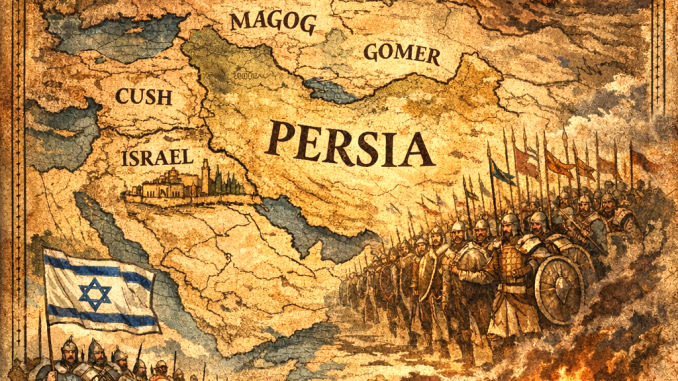
Here, Persia is listed among several nations forming a vast military alliance led by a mysterious leader named Gog, who comes from a land called Magog.
According to the text, this alliance gathers an enormous army and marches toward the land of Israel.
Other nations mentioned in the passage include:
Persia (ancient Iran)
Cush (often associated with regions in Africa, possibly Sudan or Ethiopia)
Put (commonly identified with Libya)
Gomer
Togarmah
Together, these names suggest a large and diverse coalition of forces drawn from multiple regions.
The Mystery of Gog and Magog
Perhaps the most puzzling element of the prophecy is the identity of Gog and Magog.
Over the centuries, scholars have proposed many interpretations.
Some believe Gog represents a symbolic enemy of Israel rather than a specific historical leader. Others argue that the name refers to a northern power that could emerge at a time of global instability.
In biblical literature, Gog becomes a symbol of a massive hostile force that gathers armies from many nations.
Regardless of interpretation, the prophecy describes a scenario in which a powerful alliance advances toward Israel with overwhelming strength.
Yet the story does not end with their victory.
A War That Ends in Sudden Catastrophe
According to the Book of Ezekiel, when the invading armies appear unstoppable, something extraordinary occurs.
The text describes a series of dramatic events:
A great earthquake shakes the land
Confusion spreads among the invading forces
Fire and destruction fall upon them
The coalition that seemed unstoppable suddenly collapses.
The message of the prophecy is clear: human power, no matter how vast, cannot ultimately prevail against divine judgment.
Why the Mention of Persia Matters
For modern readers, the reference to Persia is particularly intriguing.
Iran, historically known as Persia until the 20th century, has played a central role in Middle Eastern history for thousands of years.
The inclusion of Persia in Ezekiel’s prophecy suggests that the region we now know as Iran was already recognized as a major power during the prophet’s lifetime.
Yet the role of Persia in the Bible is complex.
In some passages, Persia appears not as an enemy, but as a force for good.
Persia’s Positive Role in Biblical History
In fact, one of the most respected rulers mentioned in the Bible is Cyrus the Great, the founder of the Persian Empire.
According to the biblical books of Ezra, Nehemiah, and Isaiah, Cyrus issued a decree allowing Jewish exiles to return to Jerusalem and rebuild their temple after years of captivity.
In an extraordinary passage in the Book of Isaiah, Cyrus is even referred to as “the Lord’s anointed.”
This makes Persia unique among ancient empires in biblical history.
Rather than being portrayed solely as an enemy, Persia is remembered as a civilization that played a crucial role in restoring freedom to an oppressed people.
Modern Interpretations of Ezekiel’s Prophecy
In recent decades, the prophecy of Ezekiel has gained renewed attention.
As geopolitical tensions in the Middle East continue to shape global politics, some commentators have revisited the ancient text to see whether it might offer insight into future events.
A number of modern interpreters argue that the alliance described in Ezekiel could represent a coalition of nations that might one day emerge in the region.
Some even suggest that the prophecy points to a future conflict involving multiple Middle Eastern powers.
However, many scholars caution against interpreting biblical prophecy as a literal forecast of modern politics.
Ancient prophetic literature often uses symbolic language to describe moral and spiritual themes rather than precise geopolitical predictions.
A More Controversial Interpretation
There are also more provocative interpretations of Ezekiel’s prophecy.
Some writers argue that the conflict described in chapters 38 and 39 could symbolize the eventual collapse of oppressive regimes in the region.
In this view, the war described in the prophecy is not merely a military confrontation but a dramatic transformation of political power.
The destruction of Gog’s coalition would represent the downfall of systems built on tyranny and injustice.
From this perspective, the prophecy becomes less about a single battle and more about the long struggle between oppression and freedom.
Could Ancient Prophecy Point to Future Change?
For many readers, the most fascinating question remains unanswered:
Was Ezekiel describing events that would unfold thousands of years in the future?
There is no definitive answer.
Some believe the prophecy refers to events that occurred in ancient times.
Others believe it points to a symbolic struggle that continues throughout history.
Still others believe that the final fulfillment of the prophecy lies somewhere in the future.
What is certain, however, is that the text reflects the enduring importance of the Middle East in world history.
Iran: A Nation at the Center of History
Regardless of how one interprets Ezekiel’s prophecy, one fact is undeniable.
Iran—historically known as Persia—has been one of the most influential civilizations in the world for over two millennia.
From the Persian Empire to the modern era, the region has shaped the political, cultural, and religious landscape of the Middle East.
The appearance of Persia in a biblical prophecy written thousands of years ago is a reminder of how deeply rooted Iran’s presence is in the history of the region.
Prophecy, Politics, and the Future
Today, as the Middle East continues to experience dramatic political and social changes, ancient texts like the Book of Ezekiel continue to capture the imagination of readers around the world.
For some, they offer spiritual insight.
For others, they raise profound historical questions.
But perhaps their most powerful message is timeless:
No empire lasts forever, and no system built on injustice can endure indefinitely.
History repeatedly shows that nations rise, fall, and transform in ways that no generation can fully predict.
Whether Ezekiel’s prophecy refers to past events, symbolic truths, or future possibilities, it continues to challenge readers to reflect on the forces that shape the destiny of nations.