
By : Shahbod Noori
3/21/2026


Ancient Origins of Akitu
Akitu is one of the oldest recorded festivals in human civilization, celebrated in the great cultures of ancient Mesopotamia, particularly within the Assyrian and Babylonian empires. Traditionally observed at the beginning of spring—on the first day of the month of Nisan (around April 1st today)—it marked the renewal of nature and the rebirth of life after winter.
In ancient times, Akitu was not merely a popular celebration but also a deeply religious and political event. Assyrian kings took part in elaborate rituals symbolizing the renewal of divine authority and the reaffirmation of their rule. At the same time, ordinary people celebrated with music, dance, and communal gatherings, welcoming the new cycle of life.
Meaning and Philosophy Behind the Festival
At its core, Akitu carries a universal and deeply human message: renewal, hope, and the triumph of light over darkness.
The festival reflects ancient beliefs about the cycle of life—death and rebirth, chaos and order. It reminds people that no matter how harsh the winter, spring inevitably returns. Over centuries, especially during times of hardship, exile, and displacement, this message became even more meaningful for the Assyrian people.
Akitu is not just about a new year—it is about the promise of beginning again.
Akitu in the Ancient World
In historic cities such as Nineveh and Ashur, Akitu was celebrated with remarkable grandeur. The festival often lasted up to twelve days and included:
Religious ceremonies in temples
Symbolic processions of deities
Reenactments of creation myths
Public celebrations and parades
One of the central elements was the retelling of the creation story, where order triumphs over chaos. This symbolic act reinforced hope for stability, justice, and prosperity in the coming year.
Survival Through Histor y
y

Following the fall of the Assyrian Empire and the sweeping political and religious transformations in the region, many ancient traditions disappeared. Yet Akitu survived—remarkably and defiantly.
Today, Assyrians living across Iraq, Iran, Syria, the United States, Europe, and Australia continue to celebrate this ancient festival. While its form has evolved, its spirit remains intact.
Akitu in the Modern World

Modern celebrations often include:
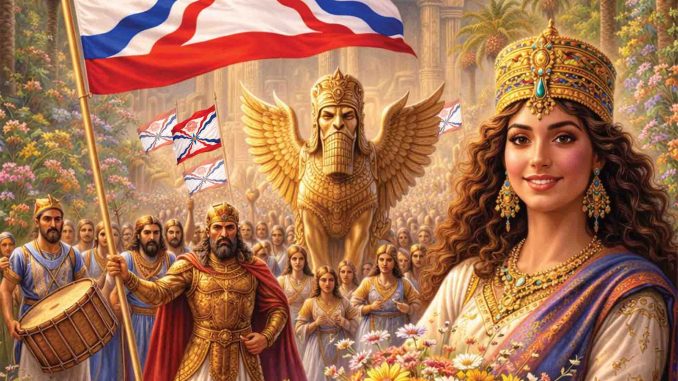
Grand parades with Assyrian flags
Traditional colorful clothing
Folk music and dance performances
Cultural and artistic programs
Community speeches and gatherings
These celebrations are not only festive—they are acts of cultural preservation, ensuring that language, heritage, and history are passed on to future generations.
The Assyrian Calendar and the Year Count
One fascinating aspect of the Assyrian New Year is its calendar system, which traces its origin back to approximately 4750 BCE. As a result, the year 2026 corresponds to the year 6776 in the Assyrian calendar.
This number is more than symbolic—it reflects a deep historical continuity. In a world where identities often fade, such a calendar stands as a declaration of endurance.
Akitu and National Identity
For a people who have endured centuries of displacement, persecution, and migration, preserving a tradition like Akitu is a remarkable achievement.
The festival helps Assyrians:
Maintain their cultural identity
Educate younger generations about their heritage
Strengthen unity within their communities
Akitu serves as a bridge between past and present—linking ancient Nineveh to modern-day cities across the globe.
Parallels with Nowruz
Interestingly, Akitu shares many similarities with the Persian New Year, Nowruz. Both celebrations:
Take place at the beginning of spring
Symbolize renewal and rebirth
Have roots in ancient civilizations
These parallels highlight the deep cultural connections among the peoples of the Middle East—connections that transcend modern borders.
The Message of Akitu Today
In a world filled with conflict, uncertainty, and change, Akitu offers a timeless message: hope, resilience, and renewal.
It reminds us that even when a people are scattered, even when their history is challenged, their culture can survive—if they choose to preserve it.
Final Thoughts
The Assyrian New Year is not just a celebration—it is a story.
A story of a people who have endured for thousands of years.
Who have faced exile, hardship, and struggle.
Yet never forgot who they are.
Akitu is a celebration of life.
A celebration of hope.
And above all, a celebration of continuity.
In a world where so much is forgotten, Akitu stands tall and declares:
We are still here.