
By : Shahbod Noori
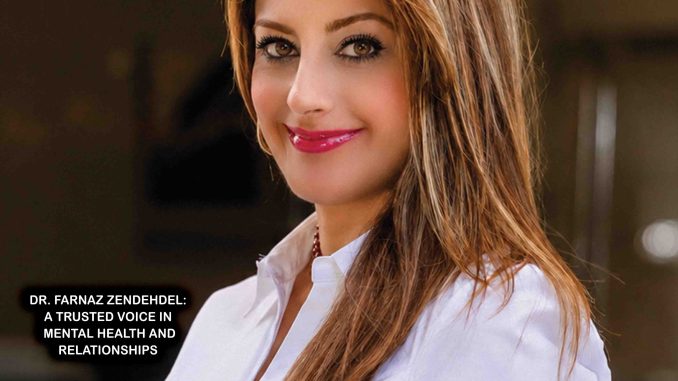
Within the Iranian-American community, some professionals become more than experts in their field — they become trusted voices people turn to during difficult moments in life. Dr. Farnaz Zendehdel is one of those respected figures. As a clinical psychologist, author, speaker, and media personality, she has spent years helping individuals, couples, and families better understand emotional health, relationships, and the complexities of modern life.

Based in Los Angeles, Dr. Farnaz Zendehdel holds a doctorate in Clinical Psychology and has dedicated much of her professional career to psychotherapy, couples counseling, family therapy, and emotional wellness. Over the years, she has become widely recognized through Persian-language television and radio programs where she discusses topics such as anxiety, depression, self-esteem, toxic relationships, parenting, emotional trauma, communication skills, and personal growth.
Her calm yet direct style of communication has made psychological concepts easier for everyday people to understand. Many viewers appreciate her ability to combine professional knowledge with practical advice that applies to real-life situations.
In addition to her clinical work and media presence, Dr. Zendehdel is also the author of the relationship-focused book “U & I,” which explores emotional compatibility, communication between partners, and the psychological foundations of healthy relationships.
Today, at a time when emotional stress, loneliness, and relationship struggles are becoming increasingly common, professionals like Dr. Farnaz Zendehdel play an important role in raising awareness about mental health within the Iranian community.
The Importance of Couples Therapy in Modern Relationships
By Dr. Farnaz Zendehdel
Modern relationships face pressures unlike any generation before. Financial stress, social media, busy careers, emotional burnout, unrealistic expectations, and constant comparison with others have made romantic relationships more fragile than ever.
Many people mistakenly believe that couples therapy is only for relationships that are falling apart or heading toward divorce. In reality, couples therapy is often most effective before relationships reach a breaking point. It is not simply about fixing problems — it is about learning how to understand each other more deeply.
One of the biggest issues couples face today is not necessarily betrayal or financial hardship. More often, it is emotional disconnection.
Two people may live under the same roof, share responsibilities, and spend years together, yet emotionally feel miles apart. Communication slowly becomes limited to daily routines, bills, schedules, or responsibilities. The emotional intimacy that once brought two people together quietly disappears.
In many relationships, partners stop truly listening to one another. Instead of listening to understand, they listen only to respond. Over time, this creates frustration, resentment, and emotional distance.
A healthy relationship requires emotional safety. People need to feel heard, respected, appreciated, and emotionally valued. When those emotional needs are ignored repeatedly, the relationship begins to weaken from within.
One important aspect of couples therapy is helping partners identify the emotional patterns they repeat unconsciously. Many reactions inside relationships are not just about the present moment. Often, they are connected to past emotional wounds, childhood experiences, family dynamics, or previous relationships.
For example, a simple disagreement about coming home late may not actually be about timing at all. It may trigger deeper feelings of rejection, abandonment, disrespect, or insecurity.
Understanding these emotional triggers is essential because unresolved emotional wounds often control reactions in relationships without people realizing it.
Another major challenge in relationships today is the issue of self-worth and emotional dependency.
Individuals who struggle with low self-esteem often experience intense jealousy, fear of abandonment, insecurity, or controlling behaviors inside relationships. Their emotional fear becomes stronger than their ability to trust.
Couples therapy helps people recognize these unhealthy emotional patterns and replace them with healthier communication and emotional balance.
In many traditional cultures, including within parts of the Iranian community, emotional expression is still difficult for many people. Men are often taught to hide vulnerability, while women may suppress their frustrations to avoid conflict or judgment.
As a result, many couples never fully communicate their emotional needs. Problems remain unspoken until years of silence eventually turn into emotional exhaustion.
Healthy communication does not mean avoiding disagreements. Every relationship experiences conflict. The difference between healthy and unhealthy relationships is not the absence of problems — it is how those problems are handled.
Strong couples learn how to disagree without destroying each other emotionally. They learn how to express frustration without humiliation, criticism, or emotional attacks.
One of the most damaging behaviors in relationships is emotional neglect. When partners stop prioritizing one another, stop showing appreciation, stop spending quality time together, or become emotionally unavailable, love slowly fades beneath routine and stress.
Relationships cannot survive on history alone. Love requires continuous attention, emotional presence, and effort.
Another important lesson couples therapy teaches is the importance of emotional accountability. Many people focus only on what their partner is doing wrong, while ignoring their own emotional behaviors.
Blame rarely heals relationships. Self-awareness does.
Therapy encourages individuals to ask difficult but necessary questions:
- How do I react during conflict?
- Do I communicate clearly or emotionally shut down?
- Do I criticize, control, or avoid?
- Am I emotionally available?
- Am I listening with empathy?
- Do I make my partner feel emotionally safe?
These questions are often uncomfortable, but they are essential for emotional growth.
Trust is another central issue in many relationships. Once trust is damaged — whether through betrayal, dishonesty, emotional withdrawal, or repeated disappointment — rebuilding it takes patience, consistency, honesty, and emotional maturity from both people.
Healing is possible, but only when both partners are willing to participate honestly in the process.
One misconception people often have is that love alone is enough to sustain a relationship. Love is important, but successful relationships also require emotional skills.
Communication is a skill.
Patience is a skill.
Conflict resolution is a skill.
Empathy is a skill.
Even apologizing sincerely is a skill.
Without emotional tools, even people who genuinely love each other may struggle to maintain a healthy relationship.
Mental health also plays a major role in relationships. Anxiety, depression, unresolved trauma, stress, addiction, or emotional instability can deeply affect communication and emotional connection between partners.
For this reason, seeking professional support should never be viewed as weakness or failure. Just as people seek medical treatment for physical health, emotional and psychological struggles also deserve professional care.
Today, conversations about mental health are becoming more open than ever before. This cultural shift is important because emotional suffering often grows worse when ignored.
Couples therapy provides a safe environment where people can speak honestly, understand one another more clearly, and rebuild emotional connection with guidance and support.
No relationship is perfect. Every couple experiences challenges, misunderstandings, and painful moments. However, many relationships can heal when both people are willing to communicate honestly, grow emotionally, and understand each other with compassion rather than judgment.
At its core, couples therapy is not simply about saving relationships. It is about helping people create healthier emotional lives — both individually and together.
And perhaps that is one of the most important reminders in today’s fast-moving world:
Strong relationships are not built by perfection.
They are built by understanding, emotional awareness, respect, and continuous effort.