
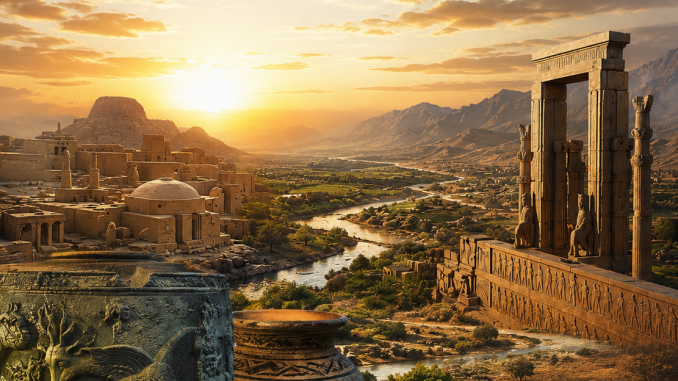
Part One: Before Iran Became Iran
The Story of the Birthplace of One of the World’s Oldest Civilizations
Thousands of years before the name Iran appeared on the maps of the world, before Cyrus the Great established one of history’s greatest empires, before Darius carved the achievements of Persia into mountains and palace walls, people were already living among the towering mountains, fertile plains, roaring rivers, and silent deserts of this remarkable land.
They could not have imagined that their homeland would one day become known as Iran—a civilization admired for its culture, wisdom, architecture, poetry, science, and resilience. Yet with their own hands they wrote the very first chapters of a story that continues to this day.
The history of Iran does not begin with Persepolis.
It does not begin with the Achaemenian kings or even with the Medes.
Its roots reach much deeper into the past—so deep that we must travel back thousands of years to a time when early humans sought shelter inside the caves of the Zagros Mountains, gathered around fire beneath the stars, and slowly learned how to transform nature into civilization.
Long before Iran became a nation, it was already a home.
A Land Between Continents
The Iranian Plateau is one of the world’s most extraordinary geographical regions. Situated between Mesopotamia, Central Asia, the Indian subcontinent, the Caucasus, and the Persian Gulf, it has always served as a natural bridge connecting civilizations.
The towering Zagros Mountains protected the western frontier, while the Alborz range overlooked the lush lands bordering the Caspian Sea. Vast deserts stretched across the center, fertile valleys flourished in the north and southwest, and countless rivers nourished early communities.
Nature here was never easy.
Winters could be harsh, summers unforgiving, and water was often scarce. Yet these very challenges shaped the character of the people who lived here. They learned how to survive, adapt, and innovate.
They discovered how to locate water beneath dry ground, how to hunt, how to make tools from stone, and eventually how to shape clay into homes and vessels.
Archaeological discoveries from the Paleolithic period demonstrate that humans inhabited different regions of today’s Iran for hundreds of thousands of years. Caves throughout the Zagros Mountains preserve evidence of some of the earliest human communities in Western Asia.
Imagine a cold evening inside one of those caves.
A fire burns quietly.
Children gather around their parents while hunters describe the day’s journey through the mountains.
Outside, wolves roam beneath a sky filled with stars.
No written language exists.
No kings.
No cities.
Only people discovering what it means to live together.
Although they were not “Iranians” in the modern sense, they became the first caretakers of a land that would one day influence much of the known world.
When Humanity Learned to Trust the Earth
One of history’s greatest revolutions did not begin with armies or conquerors.
It began with a single seed.
For countless generations, people survived by hunting wild animals and gathering edible plants. Life depended upon constant movement.
Then something extraordinary happened.
Communities living across parts of the Iranian Plateau gradually realized that seeds could be planted, crops harvested, and animals domesticated.
Instead of endlessly chasing food, people could create it.
The western regions of Iran, particularly the Zagros foothills, became some of the earliest places where agriculture and permanent settlements developed. As farming expanded, human society changed forever.
Villages appeared.
Families remained in one place.
People shared water, protected fields together, and developed new skills.
Civilization, in many ways, began at that very moment.
Picture a quiet village nearly ten thousand years ago.
A mother cleans freshly harvested grain.
Children laugh outside simple mud-brick homes.
Nearby, men dig irrigation channels while elders pass generations of knowledge to the young.
History remembers almost none of their names.
Yet every magnificent palace, every great empire, and every masterpiece of Persian civilization rests upon the work of these forgotten pioneers.
From Villages to Cities
As centuries passed, villages continued to grow.
Some became centers of craftsmanship, commerce, and administration.
People learned how to fire pottery, weave textiles, smelt copper, and trade valuable goods across enormous distances.
Caravans crossed deserts and mountain passes carrying precious stones, metals, fabrics, livestock, and agricultural products.
Iran was never merely a place travelers crossed.
It became one of humanity’s great crossroads.
Ideas traveled alongside merchants.
Technology moved with trade.
Art crossed borders long before political boundaries existed.
Even during the Bronze Age, communities throughout the Iranian Plateau maintained commercial relationships with Mesopotamia, Central Asia, and the civilizations of the Indus Valley.
Long before the Silk Road became famous, Iran already served as one of the world’s great meeting places.
Within this vast landscape, remarkable urban centers emerged—cities whose secrets remained buried beneath the earth for thousands of years.
Jiroft: A Civilization Hidden Beneath the Soil
In southeastern Iran, along the banks of the Halil River in today’s Kerman Province, lies one of archaeology’s greatest mysteries.
Jiroft.
For centuries, travelers passed these quiet plains without realizing that beneath their feet rested the remains of an advanced Bronze Age civilization.
When archaeologists began excavating the region, they uncovered magnificent carved stone vessels, intricate reliefs, monumental architecture, and evidence of sophisticated craftsmanship dating back more than five thousand years.
The artistic quality astonished scholars around the world.
Mythical creatures, exotic animals, elaborate geometric designs, and masterfully carved chlorite vessels suggested the existence of a highly organized society with skilled artisans and long-distance trade.
Yet Jiroft is also a story of loss.
Many priceless artifacts were illegally excavated and trafficked before scientific investigations could properly document them.
As a result, many questions remain unanswered.
Who were these people?
What language did they speak?
What did they call their kingdom?
Perhaps one day another excavation will uncover inscriptions capable of answering these mysteries.
Until then, Jiroft remains one of archaeology’s most fascinating unfinished stories.
What we already know, however, is enough to transform our understanding of ancient Iran.
Five thousand years ago, southeastern Iran was not an isolated wilderness.
It was home to artists, engineers, merchants, and visionaries whose achievements rivaled many better-known civilizations of the ancient world.
The Burnt City: A City That Refused to Be Forgotten
Far to the east, in today’s Sistan and Baluchestan Province, another extraordinary civilization flourished nearly five thousand years ago.
Today we know it as Shahr-e Sukhteh, or The Burnt City.
Its modern name may suggest destruction, but what archaeologists have uncovered tells a very different story—one of intelligence, creativity, innovation, and human achievement.
Founded around 3200 BC, the city occupied a strategic location along ancient trade routes connecting the Iranian Plateau with Central Asia, Mesopotamia, and the Indus Valley. It became one of the most important urban centers of the Bronze Age.
Excavations have revealed carefully planned neighborhoods, workshops, cemeteries, public spaces, and evidence of organized urban life. Craftsmen produced pottery, textiles, jewelry, wooden objects, and sophisticated tools. Trade connected the city with distant cultures, bringing valuable materials from hundreds of miles away.
Perhaps even more remarkable are the discoveries that reveal the everyday lives of its people.
Archaeologists have found evidence of advanced medical knowledge, including what is believed to be one of the earliest known artificial eyes ever discovered. Other findings suggest surprisingly sophisticated surgical practices and an understanding of anatomy that was exceptional for its time.
Fragments of painted pottery even depict sequences of movement, leading some scholars to describe them as among the earliest examples of visual storytelling—an ancient precursor to animation.
Yet beyond these extraordinary discoveries lies something even more meaningful.
Every bowl, every woven fabric, every child’s toy, and every household object reminds us that these were ordinary people living extraordinary lives.
Parents raised children.
Artists created beauty.
Merchants dreamed of prosperity.
Families laughed, celebrated, mourned, and hoped for tomorrow—just as we do today.
Fire may eventually have consumed parts of their city, but it never erased their place in human history.
Elam: A Great Civilization Before Persia
While remarkable cities flourished across eastern Iran, another powerful civilization was rising in the southwest.
Its name was Elam.
Centered around the ancient city of Susa, Elam emerged more than a thousand years before the Persian Empire. For centuries it stood among the great political and cultural powers of the ancient Near East.
The Elamites possessed their own language, religion, government, artistic traditions, and identity.
They were not simply neighbors of Mesopotamia.
They were competitors.
Sometimes allies.
Sometimes rivals.
Sometimes conquerors.
Their influence extended across much of southwestern Iran and beyond.
Susa became one of the world’s oldest continuously inhabited cities, witnessing countless generations of rulers, merchants, artisans, priests, and scholars.
The magnificent ziggurat of Chogha Zanbil, still standing today in Khuzestan Province, remains one of the finest surviving examples of Elamite architecture and one of the world’s greatest archaeological treasures.
Long before Persepolis amazed visitors from across the ancient world, Elamite builders had already demonstrated remarkable engineering and architectural skill.
The Elamites left behind exquisite bronze sculptures, beautifully carved seals, elegant pottery, and complex administrative systems.
Their civilization became one of the essential foundations upon which later Iranian kingdoms would rise.
A Civilization Thousands of Years in the Making
When many people think of ancient Iran, they immediately think of Cyrus the Great.
They think of Persepolis.
Of the Persian Empire.
Of royal palaces and magnificent kings.
Yet none of those achievements appeared suddenly.
They were built upon thousands of years of accumulated knowledge.
Generation after generation, countless anonymous men and women contributed to the civilization that would eventually become Iran.
Farmers learned to cultivate the land.
Builders mastered architecture.
Artists perfected their crafts.
Merchants connected distant civilizations.
Engineers managed water in one of the world’s most challenging landscapes.
Each generation added another stone to a foundation that would eventually support one of history’s greatest empires.
History often remembers kings.
But civilizations are built by ordinary people.
A farmer planting grain.
A mother teaching her children.
A craftsman carving stone.
A merchant crossing dangerous deserts.
A shepherd guiding his flock through mountain valleys.
These people rarely appear in history books.
Yet without them, no empire could ever have existed.
More Than Borders
Today, when we hear the name Iran, we should think of something far greater than modern political boundaries.
Iran is one of humanity’s oldest cultural landscapes.
It is a memory stretching back thousands upon thousands of years.
It is the fire burning inside ancient Zagros caves.
It is the first wheat harvested by early farmers.
It is the carved stone vessels of Jiroft.
It is the streets of the Burnt City.
It is the temples of Elam.
It is the determination of generations who transformed a rugged plateau into one of the world’s greatest centers of civilization.
Throughout history, empires have risen and fallen.
Borders have changed.
Kings have come and gone.
Yet the civilization of Iran has endured.
Its language evolved but survived.
Its culture absorbed influences yet maintained its identity.
Its poetry, philosophy, architecture, music, and traditions continued to inspire millions across centuries.
This remarkable endurance is perhaps Iran’s greatest achievement.
The story of Iran is not simply the story of rulers.
It is the story of human perseverance.
It is the story of creativity overcoming hardship.
It is the story of people who refused to surrender their identity despite wars, invasions, and changing times.
That story continues today.
Every generation becomes another chapter in a narrative that began long before written history itself.
Looking Ahead
In this first chapter, we traveled back to the dawn of civilization—before Persia, before kings, before empires.
We met the first farmers, the first builders, the first artists, and the first city dwellers who transformed the Iranian Plateau into a cradle of civilization.
But history was preparing for an even greater chapter.
New peoples would arrive.
New kingdoms would emerge.
The Medes would unite powerful tribes across western Iran.
And from among the Persians would rise a leader whose name would echo across the centuries.
A man whose ideas about leadership, justice, tolerance, and empire would influence not only Iran, but the history of the world itself.
His name was Cyrus the Great.
His story begins in our next chapter.