
Special Report
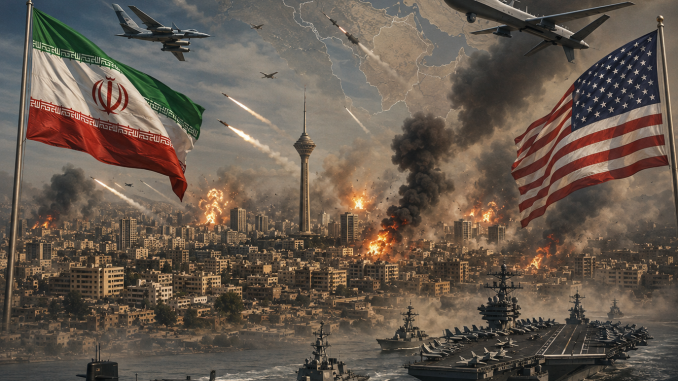
The military confrontation between the Islamic Republic of Iran and the United States has entered another dangerous stage, raising concerns that the conflict could expand well beyond the borders of the two countries. While U.S. forces continue to carry out precision strikes against military targets inside Iran, Tehran has intensified its missile and drone operations against locations linked to American forces across the Middle East. At the same time, uncertainty surrounding maritime security in the Persian Gulf, the Strait of Hormuz, and global energy markets remains one of the world’s leading concerns.
One of the most significant developments has been the continuation of U.S. air operations targeting military infrastructure associated with the Islamic Revolutionary Guard Corps (IRGC). Unlike the earlier stages of the conflict, when attacks focused primarily on missile sites, naval facilities, and air-defense systems, recent operations have expanded to include logistics centers, transportation routes, communications facilities, military storage depots, and infrastructure believed to support military operations.
According to U.S. military officials, the objective is to reduce Iran’s ability to transport weapons, coordinate military operations, and threaten international shipping lanes. American officials continue to emphasize that their campaign is directed at military capabilities rather than the Iranian population.
Hormozgan Province remains the primary center of military activity. Bandar Abbas, Iran’s largest commercial port and one of its most important naval bases, has again been the focus of repeated air strikes. Reports indicate damage to military warehouses, command centers, coastal surveillance equipment, and air-defense installations.
Although Iranian authorities have released limited information regarding the full extent of the damage, satellite imagery and international media reports suggest that military operations in southern Iran remain active. Military analysts believe the United States is attempting to gradually weaken Iran’s operational capabilities without committing ground forces, relying instead on sustained air power and naval superiority.
Additional strikes have reportedly targeted military facilities in other provinces. Western defense analysts say recent attacks have concentrated on logistical support networks, underground weapons depots, transportation infrastructure, and communications systems. The strategy appears designed to reduce Iran’s military flexibility while increasing political and economic pressure on Tehran.
Iran, meanwhile, has expanded its response beyond its own borders. Missile and drone attacks directed toward locations connected with American military operations have continued in Bahrain, Kuwait, Jordan, and Iraq. Although many incoming projectiles have reportedly been intercepted by regional air-defense systems, several attacks caused damage to military facilities and nearby infrastructure.
Iranian officials have repeatedly stated that military operations will continue as long as U.S. strikes inside Iran persist. At the same time, regional governments remain on high alert as concerns grow that additional countries could become more deeply involved in the conflict.
The Strait of Hormuz continues to be one of the world’s most closely watched strategic waterways. Commercial shipping has not stopped entirely, but many international shipping companies have altered routes, delayed departures, or increased security measures because of the heightened military risk.
Insurance costs for commercial vessels have increased substantially, while energy companies remain concerned that any disruption to oil exports could affect global markets. Because a significant percentage of the world’s crude oil passes through the Strait of Hormuz, even limited military incidents have the potential to influence international fuel prices and inflation.
Global energy markets have responded accordingly. Oil prices remain volatile as investors monitor military developments throughout the Persian Gulf. Energy analysts warn that prolonged instability could have significant economic consequences well beyond the Middle East.
Politically, President Donald Trump has continued to deliver a mixed message. On one hand, he has warned that American forces remain fully prepared to respond to any additional Iranian attacks and that military operations will continue whenever necessary to protect U.S. personnel and allies.
At the same time, President Trump has stated that diplomatic communication with Tehran has not completely ended. According to his public remarks, indirect contacts continue through diplomatic channels, although he has indicated that Iran is not yet prepared to reach a comprehensive agreement.
Those statements have fueled speculation that negotiations could eventually resume despite the ongoing military confrontation. However, most observers agree that the gap between both sides remains substantial, making an immediate diplomatic breakthrough unlikely.
Iranian officials continue to reject American military pressure and insist that their response represents legitimate self-defense. Government spokespersons and senior military commanders have declared that Iranian forces remain prepared for additional retaliatory operations if U.S. attacks continue.
Inside Iran, however, economic pressure, damage to infrastructure, transportation disruptions, and public uncertainty continue to grow. While official statements emphasize military readiness, analysts note that prolonged conflict also places increasing strain on the country’s economy and civilian population.
Internationally, European governments continue calling for restraint and renewed diplomacy. The United Nations has once again urged all parties to protect civilians and avoid attacks that could damage essential infrastructure or further destabilize the region.
Meanwhile, Russia and China continue advocating a political solution through negotiations rather than military escalation. Both governments have criticized the expansion of military operations and expressed concern that continued fighting could threaten regional stability and international trade.
Diplomatic observers believe these major powers could play an increasingly important role if serious negotiations eventually resume.
Reports and Speculation
Alongside officially confirmed developments, numerous unverified reports have circulated through social media and regional news outlets during the past several days.
Some sources have suggested that additional U.S. strikes could target more sensitive military facilities inside Iran, while others claim Tehran is preparing a broader regional response. There have also been reports that Oman and several Gulf states continue quiet diplomatic efforts aimed at reducing tensions between Washington and Tehran.
At this stage, however, many of these reports remain unconfirmed and should be viewed with caution. The only officially acknowledged diplomatic development has been the continuation of indirect contacts between American and Iranian representatives, although no concrete progress has yet been announced publicly.
Military analysts generally agree that neither side currently appears eager to launch a full-scale ground war. Such a conflict would likely involve enormous military, political, and economic costs while increasing the risk of drawing additional regional powers into direct confrontation.
Instead, experts believe the more likely scenario remains a prolonged campaign of limited air strikes, missile exchanges, cyber operations, economic pressure, and proxy activities rather than a conventional large-scale invasion.
The greatest concern continues to be the growing humanitarian impact. Damage to transportation networks, interruptions to electricity and water services in some areas, and continued uncertainty have affected the daily lives of millions of civilians.
Across the Gulf region, neighboring countries have also increased military readiness while strengthening security around airports, ports, energy facilities, and critical infrastructure.
Taken together, recent developments suggest that the crisis has not yet reached a point of de-escalation. Diplomatic channels remain open, but military operations continue simultaneously, leaving little indication that the conflict will end in the immediate future.
Many international observers believe the coming weeks could prove decisive. Either diplomatic efforts will gradually gain momentum, or the region may enter an even more dangerous phase of confrontation—one with potentially far-reaching consequences for Middle Eastern security, global energy markets, and international stability.