
By Donya Noori
07/25/2026
Graduate of Southwestern Law School and Legal Professional with the Law Offices of Camellia Jalilvand
Every day, thousands of people walk along the streets and sidewalks of California. Some are heading to work, others are taking their children to school, exercising, shopping, or simply enjoying a walk around their neighborhood. Most of them never imagine that within a matter of seconds, a traffic collision could change their lives forever.
Pedestrian accidents are among the most serious types of motor vehicle collisions because, unlike drivers and passengers, pedestrians have virtually no physical protection. Even a vehicle traveling at a relatively low speed can cause broken bones, head injuries, spinal trauma, or other life-changing injuries.
For this reason, understanding your legal rights as a pedestrian is extremely important.
Is the Driver Always at Fault?
One of the most common misconceptions is that the driver is automatically responsible whenever a pedestrian is struck by a vehicle.
In reality, the law requires that every accident be evaluated based on its own facts.
Drivers have a legal responsibility to operate their vehicles safely, obey traffic laws, remain alert, and watch carefully for pedestrians.
Pedestrians also have responsibilities, including following traffic signals whenever possible, crossing at designated crosswalks, and exercising reasonable care for their own safety.
Because every collision is unique, determining legal responsibility often requires a careful review of all available evidence.
If the Accident Happens in a Crosswalk
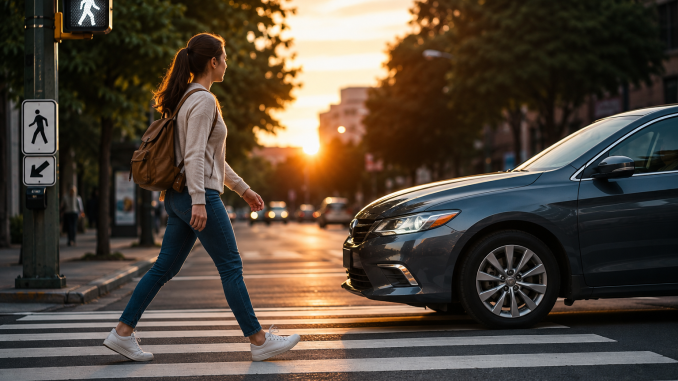
Many pedestrian accidents occur at marked intersections or crosswalks.
Drivers are generally expected to pay close attention to pedestrians who are lawfully crossing the street. However, simply being inside a crosswalk does not automatically determine every legal issue in a case.
Investigators may consider numerous factors, including traffic signals, vehicle speed, visibility, weather conditions, road design, and witness statements before reaching conclusions about how the collision occurred.
Each case deserves an individual analysis.
What If You Were Crossing Outside a Crosswalk?
People sometimes cross mid-block because it appears quicker or more convenient.
Although this may complicate the legal analysis, it does not automatically eliminate a person’s legal rights.
For example, the driver may have been speeding, distracted by a mobile phone, driving aggressively, or failed to react when there was sufficient time to avoid the collision.
Surveillance video, witness testimony, photographs, police reports, and other evidence may all become important in determining what actually happened.
What Should You Do After the Accident?
Your health should always be your first priority.
If you are able, call 911 or ask someone nearby to request emergency medical assistance.
Even if your injuries appear minor, it is important to receive a medical evaluation because some injuries—particularly head, neck, back, or internal injuries—may not become noticeable until hours or even days later.
If it is safe to do so, photograph the accident scene, vehicle damage, traffic signals, road conditions, and any visible injuries.
You should also obtain the driver’s name, insurance information, license plate number, and the names and contact information of any witnesses.
Why a Police Report Matters
Some people choose not to contact law enforcement because they believe the accident is not serious enough.
However, a police report often becomes one of the most valuable pieces of evidence in a personal injury case.
The report may document the location of the collision, road conditions, witness information, vehicle positions, and the statements provided by those involved.
Although a police report does not automatically determine legal liability, it frequently plays an important role during the investigation.
Be Careful When Speaking With Insurance Companies
Following an accident, insurance adjusters may contact you quickly.
While you should always be truthful, avoid guessing about details you do not know or minimizing your injuries before your medical condition has been fully evaluated.
Many people sincerely believe they are “fine” immediately after an accident, only to discover significant injuries several days later.
For that reason, it is often wise to understand the full extent of your injuries before making important decisions regarding your claim.
A Case Is About More Than Medical Bills
Many people believe the value of an injury claim depends only on hospital expenses.
In reality, every case is different.
Factors such as the seriousness of the injuries, recovery time, lost income, future medical treatment, physical pain, emotional suffering, and the impact on daily life may all become important considerations when evaluating a claim.
No two pedestrian accident cases are exactly alike.
The Importance of Video Evidence
Today, many intersections, businesses, apartment buildings, and private homes are equipped with security cameras.
In some cases, surveillance footage provides the clearest evidence of exactly how a collision occurred.
Because many recording systems automatically overwrite older footage after a short period of time, valuable evidence may disappear if it is not preserved promptly.
This is one reason why timely action after an accident can be extremely important.
Knowledge Can Protect You
No one expects to be struck by a vehicle while walking across the street.
However, understanding your legal rights before an accident occurs can help you make informed decisions during a stressful and confusing time.
Seeking prompt medical care, preserving important evidence, cooperating with investigators, and understanding your legal options can all help protect your interests.
The law exists to promote fairness, and knowing your rights allows you to make informed choices if the unexpected happens.
About the Author
Donya Noori is a graduate of Southwestern Law School and works with the Law Offices of Camellia Jalilvand in Los Angeles. Her professional experience focuses primarily on automobile accident and personal injury matters.
This article is provided for educational and informational purposes only and should not be considered legal advice for any specific situation.
If you have questions regarding a pedestrian accident, automobile collision, or personal injury matter, you may contact the Law Offices of Camellia Jalilvand and request to speak with Donya Noori.