
by shahbod noori
08-04-2026
Real Change Begins with Each of Us
In an age marked by remarkable advances in science, technology, and communication, one would expect society to become more organized, more trustworthy, and more compassionate. Yet despite all our progress, many of the challenges we face today are not caused by a lack of resources or knowledge. Instead, they stem from something far more fundamental—the gradual decline of personal responsibility.
Responsibility is more than fulfilling an obligation or following a set of rules. It is a way of thinking and living. A responsible person understands that every decision, every promise, and every action carries consequences—not only for themselves but also for the people around them. Rather than looking for someone else to blame, they first ask themselves, “What is my role in solving this problem?” That simple question has the power to transform families, workplaces, and entire communities.
The foundation of responsibility is built at home. Children do not learn responsibility from lectures alone; they learn it by observing the behavior of parents and family members. When children are encouraged to keep their promises, care for their belongings, respect others, and accept the consequences of their actions, they grow into adults who value accountability. On the other hand, when excuses replace responsibility and others are always blamed for mistakes, those habits often continue throughout life.
Schools also play an essential role. Education should never be limited to mathematics, science, or literature. It should also teach honesty, discipline, cooperation, respect, and accountability. A society can produce thousands of highly educated professionals, but without responsibility, education alone cannot create a strong nation. Knowledge is powerful only when it is guided by integrity and commitment.
The workplace is another place where responsibility shapes success. Businesses do not thrive simply because they have modern equipment or financial resources. They succeed because people keep their commitments. Employees who perform their duties with care, managers who admit their mistakes, business owners who treat customers fairly, and employers who honor their obligations all contribute to an environment built on trust. In today’s competitive world, trust is often a company’s most valuable asset.
Responsibility also appears in the ordinary moments of everyday life. Following traffic laws, respecting other people’s time, standing in line patiently, keeping public spaces clean, conserving water and energy, paying bills on time, and treating neighbors with courtesy may seem like small acts. Yet when millions of people practice these habits consistently, they create safer neighborhoods, stronger communities, and a higher quality of life for everyone.
In recent years, social media has become one of the most influential parts of modern life. With a single click, anyone can share news, opinions, or information with thousands of people. This freedom is valuable, but it also comes with responsibility. Sharing false information, spreading rumors, or attacking others online can have lasting consequences. Every social media user is, in many ways, a small publisher. Just as professional journalists are expected to verify facts and act ethically, individuals also have a responsibility to think carefully before posting or sharing content.
One characteristic shared by successful societies is that citizens do not expect governments alone to solve every problem. They recognize their own role in improving the community. When they see litter, they pick it up. When a neighbor needs help, they offer assistance. When local organizations need volunteers, they participate. They understand that a healthy society is built not only by public institutions but also by ordinary people who care enough to make a difference.
The Iranian community, both inside Iran and throughout the world, has countless examples of responsible individuals. Dedicated teachers who inspire future generations, healthcare professionals who serve their patients with compassion, firefighters and emergency responders who risk their lives to protect others, entrepreneurs who create jobs, and volunteers who support charitable causes all demonstrate that responsibility remains one of our greatest strengths. These individuals remind us that meaningful change often begins with quiet acts of dedication rather than dramatic headlines.
Accepting responsibility is not always easy. It is often simpler to blame circumstances, other people, or bad luck. However, history has repeatedly shown that progress begins the moment individuals decide to take ownership of their actions. Communities grow stronger when people ask not only what others should do, but what they themselves can contribute.
If each of us chooses to become a little more responsible—in our families, workplaces, neighborhoods, and online communities—the effects will extend far beyond our own lives. Greater responsibility leads to greater trust. Greater trust encourages stronger cooperation. Stronger cooperation builds healthier economies, more stable communities, and brighter opportunities for future generations.
A culture of responsibility cannot be created by laws alone. It cannot be forced through regulations or achieved by government policies. It is built one decision at a time, one promise kept at a time, and one act of integrity at a time. Every time we admit a mistake, keep our word, respect another person’s rights, or contribute positively to our community, we help build a better future.
Perhaps the greatest transformation our world needs today is not another technological breakthrough or another economic achievement. It is a renewed commitment to personal responsibility. When individuals accept responsibility for their own actions, families become stronger, businesses become more trustworthy, communities become more united, and nations become more resilient.
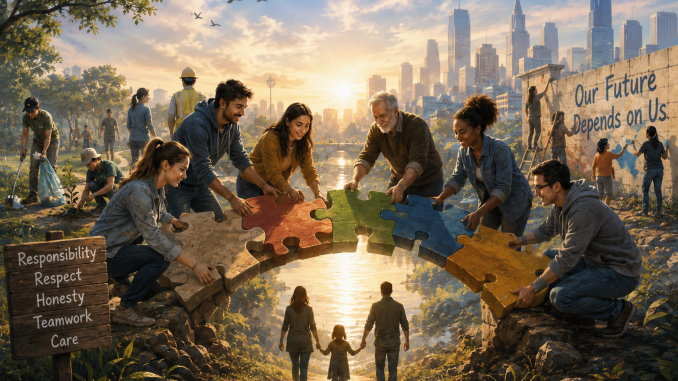
Real change does not begin in government offices or corporate boardrooms. It begins with ordinary people making extraordinary choices every day. By accepting responsibility for our words, our actions, and our shared future, we become the architects of a society built on trust, respect, and hope. That is the foundation upon which every successful and lasting civilization is built.