
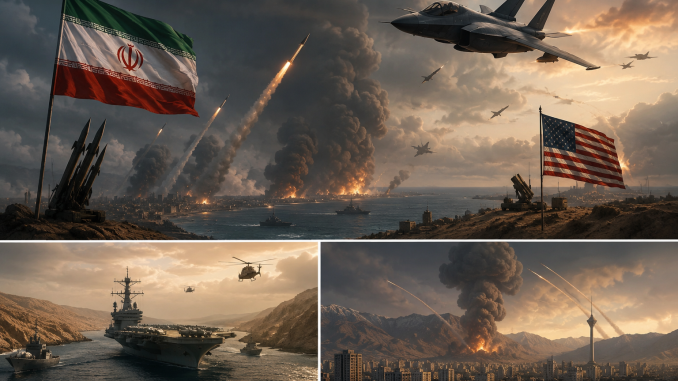
Over the past week, tensions involving the Islamic Republic of Iran, the United States, and Israel have remained high. Although none of the parties has expressed a desire to launch a full-scale ground war, aerial strikes, missile exchanges, maritime incidents, and economic pressure have continued, leaving little indication that the crisis will ease in the immediate future.
The most significant development this week was the continuation of U.S. airstrikes against facilities associated with Iran’s Islamic Revolutionary Guard Corps (IRGC). The U.S. Central Command (CENTCOM) announced that multiple military targets, including command centers, missile storage sites, drone facilities, and coastal surveillance systems, had been struck. Washington described these operations as a direct response to recent Iranian missile and drone attacks against U.S. personnel and military installations in the region.
In response, Iran launched a limited number of missile and drone attacks targeting U.S. military bases in several Gulf countries. According to available reports, most of the incoming projectiles were intercepted by regional air defense systems, and no significant casualties were reported. Nevertheless, the attacks demonstrated that Tehran continues to maintain the capability to project military force across the region.
One of the week’s most sensitive issues involved the Strait of Hormuz. Iranian authorities reported stopping or redirecting several commercial vessels, increasing international concerns about the security of one of the world’s most critical energy shipping routes. These developments pushed global oil prices higher, while many international shipping companies adopted additional security precautions before entering the Gulf.
Meanwhile, Saudi Arabia proposed the formation of a multinational maritime coalition to safeguard commercial shipping in regional waters. Oman also intensified diplomatic efforts to establish a mechanism for protecting maritime traffic through the Strait of Hormuz, although no comprehensive agreement has yet been reached among the parties involved.
On the political front, the United States reiterated that it has not ruled out diplomacy but insisted that any negotiations would require a reduction in Iranian attacks and a broader de-escalation of regional hostilities. American officials also warned that any future attacks against U.S. forces or interests would be met with stronger military responses.
Inside Iran, President Masoud Pezeshkian called on the public to remain united in the face of growing external pressure. At the same time, various reports suggested continuing disagreements among political and military leaders over how the government should respond to the escalating crisis. Analysts believe these internal differences could complicate any future diplomatic initiatives.
Israel also maintained a high level of military readiness throughout the week. In addition to strengthening its missile defense systems, the Israeli military continued operations targeting Iranian-backed groups in Lebanon and elsewhere in the region. Tensions along Israel’s northern border remained elevated as both Israeli forces and Hezbollah maintained heightened alert status.
Global financial markets also reacted to the ongoing instability. Rising oil prices, concerns over potential disruptions to energy exports, and fears that the conflict could spread to additional countries in the Middle East contributed to increased market volatility. Economists warned that prolonged instability in the Gulf could fuel inflation worldwide and place additional pressure on energy-importing nations.
Overall, this week’s developments demonstrated that while none of the principal actors appears eager to initiate a full-scale regional war, the continuation of reciprocal military strikes, economic pressure, and growing insecurity in vital maritime corridors continues to raise the risk of a broader conflict. Many observers believe the coming days and weeks will be critical in determining whether the crisis moves toward further escalation or renewed diplomatic negotiations