
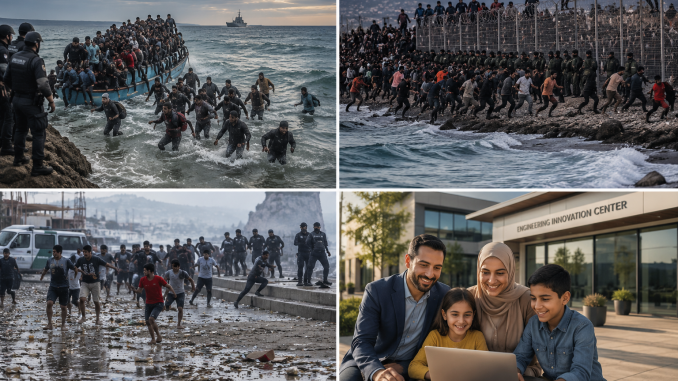
In recent years, waves of migration and asylum seekers have become one of Europe’s greatest political, economic, and social challenges. Yet the events that unfolded in recent days along the Morocco–Spain border have once again raised an urgent question: Can Europe continue to absorb large numbers of refugees while preserving public order and social stability?
Within a very short period, thousands of migrants attempted to reach the Spanish enclave of Ceuta from Morocco. Images of overcrowded border crossings, clashes with security forces, damaged vehicles, and desperate crowds shocked public opinion across Europe. Spanish authorities described the situation as one of the most serious border crises in recent memory, while several European governments renewed calls for stronger protection of the European Union’s external borders.
However, if we look only at the scenes of chaos, we tell only half of the story.
Many of those attempting the dangerous journey are young men and women who have spent years struggling with unemployment, poverty, political instability, or the complete absence of opportunity. Some families sold everything they owned to finance the journey. Others survived for weeks with little food or clean water. Thousands have lost their lives in the Mediterranean Sea over the past decade while pursuing nothing more than the hope of a safer future.
Hunger, poverty, and hopelessness can drive human beings to extraordinary risks. When life at home offers no future, even a dangerous journey across the sea may appear less frightening than staying behind.
Yet this painful reality cannot become a justification for breaking the law.
Reports and images emerging from the recent unrest included incidents of looting, vandalism, and attacks on public property. Even if such actions were carried out by only a small minority, their consequences extend far beyond those directly involved. The behavior of a few can dramatically influence how millions of Europeans perceive all migrants and refugees.
Today, Europe finds itself confronted with two very different images of immigration.
On one side stands the physician, engineer, entrepreneur, nurse, researcher, university student, or small business owner who works hard, pays taxes, raises a family, and contributes to the country’s economy and culture.
On the other side is a much smaller group involved in criminal activity, organized gangs, drug trafficking, theft, or violence. Their actions often dominate headlines and unfortunately shape public opinion far more than the quiet successes of millions of law-abiding immigrants.
This sharp contrast has transformed immigration into one of Europe’s most politically sensitive issues.
There are countless examples of successful integration.
Across Germany, France, Canada, the United States, Australia, the Netherlands, and the Scandinavian countries, millions of immigrants have become respected professionals, business owners, educators, scientists, healthcare workers, and community leaders. They have built successful careers, educated their children, paid taxes, created jobs, and strengthened the societies that welcomed them.
At the same time, some European cities have struggled with neighborhoods facing persistent unemployment, organized crime, social isolation, and public safety concerns. Experts generally agree that these problems should not be attributed to immigration itself, but rather to a combination of poverty, inadequate integration policies, limited educational opportunities, weak social support, and the actions of a relatively small number of offenders.
The truth is that immigration is neither inherently good nor inherently bad.
Everything ultimately depends on human choices.
Two families may arrive in the same country on the same day under identical circumstances.
Years later, one family’s child may become a physician saving lives, while another may become involved in organized crime.
The host country offered both families the same opportunity. The difference lies in the path each individual chooses.
Europe itself has also made mistakes.
In some cases, governments assumed that providing housing alone would be sufficient. Yet successful integration requires much more than physical shelter. Learning the language, understanding local laws, respecting cultural values, acquiring professional skills, and participating actively in society are all essential elements of becoming part of a new community.
Without these foundations, frustration, isolation, and social division can grow.
Another major factor often overlooked is the role of human trafficking networks.
Criminal organizations exploit desperate people by promising unrealistic futures in Europe. Many migrants are led to believe that employment, housing, and financial security will automatically follow once they arrive. The reality is often far more difficult. These false promises continue to encourage dangerous journeys that cost countless lives every year.
Host societies also have legitimate expectations.
Every nation has the right to protect public safety, maintain the rule of law, and defend both public and private property. No country can be expected to tolerate violence, looting, vandalism, or attacks on innocent citizens.
At the same time, millions of honest immigrants who respect the law should never be judged by the misconduct of a small minority.
Perhaps the greatest mistake is to embrace either extreme.
It is unjust to label every refugee as a criminal.
It is equally irresponsible to ignore genuine security concerns or deny that some individuals abuse the hospitality extended to them.
Both positions fail to recognize the complexity of reality.
Europe today needs balanced immigration policies—policies that protect borders, combat human trafficking, support refugees who genuinely seek safety, encourage successful integration, and respond firmly and fairly to those who violate the law.
Seeking asylum should never be viewed as receiving benefits without accepting responsibilities.
Just as citizens are expected to obey the law, refugees and immigrants also carry the responsibility of respecting the legal system, cultural norms, democratic values, and social expectations of the countries that offer them protection.
The countries from which people flee also bear responsibility.
As long as war, corruption, poverty, political oppression, economic collapse, and the lack of opportunity continue across parts of Africa and the Middle East, migration pressures will remain. No wall, fence, or border barrier can permanently solve a humanitarian crisis whose roots lie far beyond Europe’s frontiers.
Perhaps the greatest lesson of our time is that human beings should never be judged by a single label.
“Refugee” is not a moral identity; it is a legal status.
Character is defined not by where someone comes from, but by how they choose to live.
Those who work honestly, obey the law, contribute to society, and build better futures for their families become valuable members of any nation that welcomes them.
But those who respond to the generosity of their host country with crime, violence, or disrespect for the law do more than damage their own future. They also undermine public trust and make life more difficult for countless refugees whose only dream is to live in peace, dignity, and freedom.