
Law for Everyone with Donya Noori
Graduate of Southwestern Law School and Legal Professional with the Law Offices of Camellia Jalilvand
A supermarket parking lot, shopping center, restaurant, office building, or apartment garage may seem like one of the safest places to drive. Vehicles usually travel at low speeds, distances are short, and drivers are expected to be cautious.
Yet parking lots are the scene of countless accidents.
A driver begins backing out of a parking space while another vehicle travels through the lane. Two cars reverse from opposite spaces at the same time. A driver turns a corner without seeing another vehicle—or a pedestrian suddenly appears behind a car.
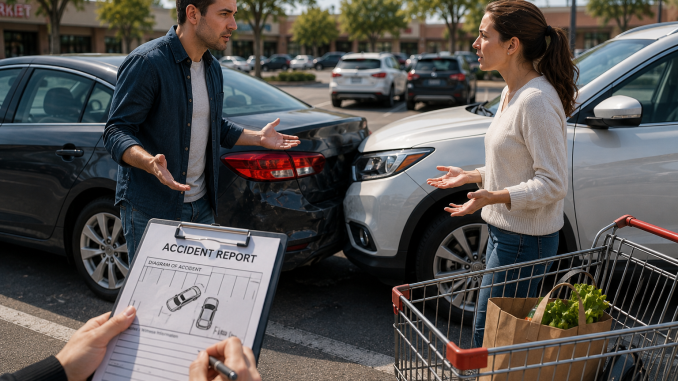
Then comes the difficult part: both drivers insist, “It wasn’t my fault.”
So how is responsibility determined when an accident happens in a parking lot?
Do Traffic Rules Still Apply in Parking Lots?
Yes. The fact that an accident occurs on private property does not mean drivers are free from their responsibility to operate vehicles carefully.
Drivers are expected to use reasonable caution when moving through parking areas, backing out of spaces, turning, and watching for pedestrians and other vehicles.
However, determining fault in a parking lot can sometimes be more complicated than determining fault on a regular street because there may be fewer traffic signals, lane markings, or signs.
That makes the details of the accident particularly important.
When a Vehicle Is Backing Out
One of the most common parking lot accidents occurs when a driver reverses out of a parking space and collides with a vehicle traveling through the parking aisle.
Investigators may examine whether the reversing driver checked that the lane was clear before entering it.
But that does not necessarily mean the backing driver is automatically responsible for every accident.
The speed of the other vehicle, visibility, direction of travel, and whether either driver had an opportunity to avoid the collision may also become important.
What If Both Cars Were Backing Up?
This can be one of the more complicated parking lot accidents.
Imagine two vehicles parked on opposite sides of the same aisle. Both drivers begin reversing at approximately the same time, and the rear portions of their vehicles collide.
Determining responsibility may require examining surveillance video, vehicle damage, witness statements, and the exact location and angle of impact.
In some situations, responsibility may be shared between the drivers rather than assigned entirely to one person.
Hitting a Parked Vehicle
If you strike an unattended parked vehicle, do not simply drive away because the damage appears minor.
A small scratch or dent may seem insignificant, but leaving the scene without taking the legally required steps can create a much more serious problem.
When the owner is not present, drivers should make sure they understand and follow the applicable requirements for providing information and reporting the collision.
The size of the damage does not make the accident disappear.
Security Cameras Can Be Important Witnesses
Many shopping centers, supermarkets, apartment buildings, and public parking facilities now have security cameras.
When two drivers provide conflicting versions of an accident, video footage may help establish what actually happened.
However, surveillance footage may not be stored indefinitely.
If you believe a nearby camera captured the collision, it may be important to act promptly to determine whether the footage can be preserved through the appropriate process.
Waiting too long could mean valuable evidence is automatically erased.
Photograph the Scene, Not Just the Damage
A common mistake after a parking lot collision is taking several close-up photographs of a damaged bumper and nothing else.
Those photographs are useful, but they may not tell the entire story.
If it is safe, take wider photographs showing the positions of the vehicles, parking spaces, traffic lanes, Stop or Yield signs, pavement markings, entrances and exits, and anything that may have blocked a driver’s view.
A photograph taken immediately after the collision may preserve details that everyone forgets several weeks later.
Independent Witnesses Can Make a Difference
Busy parking lots usually have other people nearby.
Someone walking toward a store, sitting inside another vehicle, or returning a shopping cart may have seen exactly what happened.
If someone tells you they witnessed the collision, ask for their name and contact information.
An independent witness can become especially important when both drivers tell completely different stories.
Can You Be Injured in a Low-Speed Parking Lot Accident?
Yes.
Low speed does not automatically mean there can be no physical injury.
Depending on the circumstances, even a low-speed impact can result in neck, back, shoulder, or other injuries. Pedestrians in parking lots are particularly vulnerable because they have little protection from moving vehicles.
If you experience pain or unusual symptoms after a collision, take your health seriously and seek appropriate medical evaluation when necessary.
The appearance of the vehicles alone does not determine whether someone has been injured.
Should You Call the Police?
Every accident is different.
When injuries are involved, another driver refuses to exchange information, a serious dispute develops, or other circumstances require police assistance, contacting law enforcement may be important.
Even when an officer is not dispatched to the scene, you should understand whether there are reporting requirements that apply to your particular accident.
Avoid Making Immediate Admissions
After an accident, some people instinctively say, “I’m sorry. It was my fault.”
They may simply be trying to be polite, even though no one yet knows exactly what happened.
Remain calm, check whether anyone needs medical assistance, exchange the necessary information, and accurately describe what you observed. But avoid reaching immediate conclusions about responsibility before all the facts are known.
The same applies to accusing the other driver. An argument in a parking lot will not determine legal responsibility.
Evidence will.
What If the Damage Looks Minor?
Sometimes both drivers look at their bumpers and decide, “There’s almost no damage. Let’s forget about it.”
Perhaps the damage really is minimal. However, some vehicle damage may not be immediately visible, and physical symptoms can sometimes develop later.
At a minimum, exchanging information and taking photographs can help protect everyone involved.
A few minutes spent documenting an accident may prevent hours of disagreement later.
Final Thoughts
A parking lot accident may appear much simpler than a major freeway collision, but determining responsibility is not always easy.
Who was backing up? Who was traveling through the aisle? How fast were the vehicles moving? Was visibility blocked? Were there traffic signs? Did a security camera or independent witness capture what happened?
All of these details may matter.
After an accident, remain calm, exchange information, photograph the scene, identify witnesses, and place your health first if you are injured.
Weeks later, the most reliable evidence may not be what either driver remembers. It may be the photograph, video recording, or witness information collected during those first few minutes.
About the Author
Donya Noori is a graduate of Southwestern Law School and works with the Law Offices of Camellia Jalilvand in Los Angeles. Her professional experience focuses primarily on automobile accident and personal injury matters.
This article is provided for educational and informational purposes only and should not be considered legal advice for any specific situation.
If you have questions regarding an automobile accident or personal injury matter, you may contact the Law Offices of Camellia Jalilvand and request to speak with Donya Noori.