
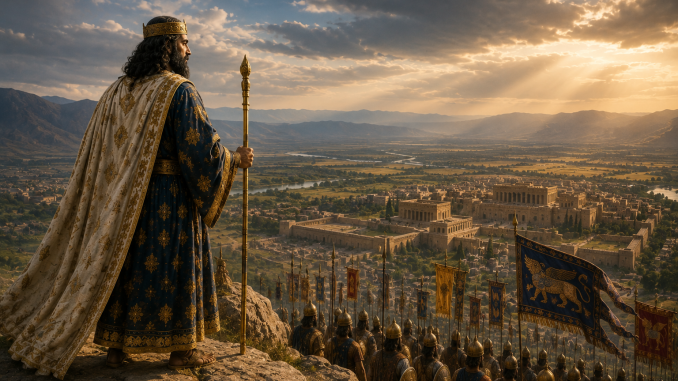
IRAN: The Eternal Land
More than 2,500 years ago, in the southern Iranian land known as Persia, a ruler emerged whose name would become part not only of Iranian history, but of world history.
His name was Cyrus the Great.
Before Cyrus, the Medes had established a major power in western Iran, Babylon was one of the richest centers of civilization, and powerful kingdoms dominated the ancient Near East. Few could have imagined that a ruler from Persia would transform the political map of this world within a few decades.
Yet Cyrus is remembered for more than conquest. His lasting reputation is closely connected to the way he governed different peoples, religions, and traditions within his expanding empire.
From Persia to Media
Cyrus was born around the beginning of the sixth century BCE and belonged to the Achaemenid royal family. His father, Cambyses I, ruled the Persians.
Many legends surround Cyrus’s childhood. The Greek historian Herodotus tells a dramatic story in which the Median king Astyages dreams that his grandson will overthrow him and orders the child killed. Cyrus survives, grows to adulthood, and eventually fulfills the prophecy.
It is a fascinating story, but historians cannot treat every detail as established fact.
What we know more securely is that by the middle of the sixth century BCE, Cyrus had become ruler of Persia and challenged Median authority.
Around 550 BCE, Astyages was defeated and Ecbatana, the Median center of power, fell to Cyrus.
But Cyrus did not simply destroy everything that had existed before him.
Median nobles, soldiers, and traditions continued to play important roles under the new order. Instead of eliminating the former enemy, Cyrus incorporated much of its strength into his expanding kingdom.
The Medes and Persians became two major pillars of a new imperial power.
The Conquest of Lydia
To the west stood Lydia, a wealthy kingdom in Asia Minor ruled by the famous King Croesus.
Conflict followed.
Cyrus defeated Lydia and captured its capital, Sardis. With this victory, Persian influence expanded dramatically westward, bringing Cyrus into direct contact with the Greek cities of Asia Minor.
The ruler who had begun in Persia was rapidly becoming one of the most powerful monarchs of the ancient world.
But his most famous conquest was still ahead.
The Gates of Babylon
Babylon was far more than a city. It was one of the great centers of ancient civilization, famous for its temples, scholarship, religious traditions, and enormous wealth.
In 539 BCE, Cyrus’s forces defeated the Babylonian army and took control of Babylon.
What happened afterward became central to his historical reputation.
Ancient conquest could bring destruction, looting, and the humiliation of defeated populations. Babylonian records, including the famous Cyrus Cylinder, instead present the new ruler as a restorer of order who respected local religious traditions. The text describes the restoration of sanctuaries and the return of certain displaced peoples and religious objects.
The Cyrus Cylinder is sometimes called the world’s first declaration of human rights. That description is popular but historically debated. It was an ancient royal proclamation, not a human-rights charter in the modern legal sense.
Even so, the policies associated with Cyrus toward local religions and traditions remain an important feature of his rule.
A Persian King Remembered in the Bible
Cyrus holds an extraordinary place in Jewish tradition.
After Babylon had conquered Judah, part of the Jewish population was exiled to Babylonia. Under Persian rule, displaced communities were permitted to return and restore their religious institutions.
Because of this, Cyrus is remembered with unusual respect in the Hebrew Bible. The Book of Isaiah even refers to him using a title often translated as the Lord’s “anointed.”
For a non-Jewish king, this was remarkable.
A ruler born in Persia had entered the religious memory of another people thousands of miles from his homeland.
Governing an Empire of Many Peoples
Winning an empire and governing one are very different challenges.
Cyrus ruled territories inhabited by people speaking different languages and following different religions and customs. Attempting to erase every local identity would have made such an empire almost impossible to govern.
The Achaemenid system, developed further by Cyrus’s successors, often relied upon existing local institutions while maintaining royal authority, military power, and taxation.
This was not democracy, nor was the Persian Empire a modern liberal state. It remained an ancient monarchy backed by military force.
But its ability to accommodate remarkable cultural diversity became one of its defining strengths.
Cyrus appears to have understood a principle that many conquerors ignored: ruling a people does not always require destroying who they are.
Pasargadae
In the plain of Fars, Cyrus established Pasargadae, the first great dynastic center of the Achaemenid Empire.
Its palaces and gardens reflected a new imperial style, bringing together artistic and architectural influences from different regions.
Yet the monument most closely associated with Cyrus is surprisingly simple.
His traditional tomb at Pasargadae consists of a small stone chamber standing above a series of massive steps.
There is something powerful about its simplicity.
A king whose empire reached across enormous distances is remembered in his homeland by a monument that is dignified rather than extravagant.
More than twenty-five centuries later, it still stands.
Why Cyrus Still Matters
Many conquerors came after Cyrus. Some ruled enormous territories and won spectacular battles. Yet relatively few are remembered in the same way.
Perhaps the reason is that Cyrus’s legacy is not only about obtaining power. It is also about how power can be used.
We should not turn Cyrus into a flawless mythical figure. He was an ancient king who built an empire through warfare and conquest.
But within the often brutal political world of antiquity, his approach toward conquered peoples created a distinctive historical reputation—one that survived long after his empire disappeared.
For Iranians, Cyrus represents a turning point when Persia emerged from the Iranian Plateau to become one of the central powers of the ancient world.
His empire would survive him and grow even larger.
Another extraordinary ruler would soon reorganize its administration, strengthen its roads and communications, reform its systems of government, and begin construction of one of the most magnificent monuments ever created in Iran.
His name was Darius the Great.
Next Week: Darius the Great — The King Who Organized the Persian Empire and Began Persepolis.