
by: fatemeh Pouresmaeil
8/31/2026
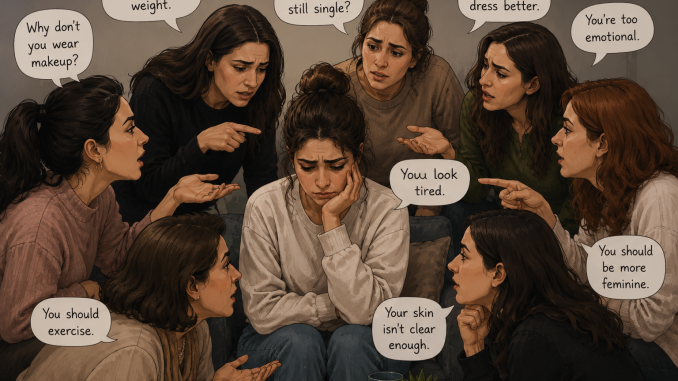
When age, weight, beauty, and clothing become measures of a woman’s worth
“You’ve gained weight.”
“Why are you so thin?”
“Your hair is turning gray.”
“You’re too old to dress like that.”
“Why don’t you take better care of yourself?”
“Why are you wearing so much makeup?”
It may be difficult to find a woman who has never heard at least one of these comments. What makes the situation even more frustrating is that the criticism is often contradictory. If a woman does not wear makeup, someone may say she has stopped caring about herself. If she does wear makeup, someone else may ask why she is trying so hard to attract attention.
If she is thin, people comment. If she gains a few pounds, her weight can suddenly become a topic of conversation at a family gathering.
The real issue is not beauty itself. The deeper problem is a culture that too often connects a woman’s value to her appearance.
It Begins in Childhood
This pressure rarely begins in adulthood.
At a family gathering, someone may look at a little girl and say, “She’s becoming so beautiful.” Another child may hear, “She would be so pretty if she lost a little weight.”
The adults may mean no harm, but children listen.
A girl who repeatedly hears comments about her weight, skin, hair, or facial features may gradually begin to believe that a large part of her value depends on what others see when they look at her.
She may be intelligent, compassionate, creative, athletic, or artistically gifted, yet most of the compliments she receives may still focus on her appearance.
Over time, the message becomes difficult to ignore: how you look matters more than who you are.
A Standard No Woman Can Ever Win
Women are often expected to be attractive—but not so attractive that they draw “too much” attention. They should look young, but should not appear desperate to remain young. They should dress well, but their clothing should not invite criticism. They should maintain a certain body shape, but should not seem “obsessed” with diet or exercise.
It is a competition with no finish line.
If a woman decides not to color her gray hair, someone may say she has let herself go. If she chooses cosmetic procedures, others may ask why she could not simply age naturally.
The problem is not what a woman chooses.
The problem is society’s belief that everyone is entitled to judge that choice.
Social Media: A Mirror That Is Not Real
In previous generations, women might compare themselves with relatives, friends, models, or movie stars. Today, a smartphone can place hundreds of supposedly “perfect” women in front of us within minutes.
Perfect skin. Perfect bodies. Beautiful homes. Luxury vacations. Happy relationships. Endless smiles.
But what appears on a screen is not necessarily reality.
Lighting, camera angles, filters, makeup, photo editing, and carefully selected moments can create an image that even the person in the photograph does not resemble in everyday life.
Constantly comparing a real body and a real life to edited images can contribute to dissatisfaction, insecurity, and declining self-confidence.
A woman may begin asking, “Why don’t I look like that?” without realizing that sometimes even the woman in the photograph does not actually look like that.
When Insecurity Becomes a Business
There is nothing inherently wrong with the beauty industry. Fashion, cosmetics, skincare, hairstyling, and even cosmetic procedures can be personal choices that bring enjoyment and confidence.
The problem begins when selling a product requires first convincing a woman that something is wrong with her.
The wrinkles must disappear.
The hair must change.
The stomach must become flatter.
The nose must become smaller.
The skin must remain young.
The hidden message can become: “You are not good enough as you are.”
And a marketplace built around insecurity becomes more profitable when people are never completely satisfied with themselves.
Why Do Men and Women Seem to Age Differently?
In many cultures, aging in men can be associated with experience, maturity, authority, and even attractiveness. Gray hair on a man is sometimes considered distinguished.
Women often face a different standard.
They may feel pressure to fight every visible sign of aging, as though growing older represents failure.
But wrinkles can also represent years of laughter, tears, work, motherhood, relationships, disappointment, recovery, and life itself.
Why should evidence of having lived be treated as something shameful?
There is nothing wrong with wanting to look healthy and attractive. But there is a major difference between taking care of yourself and living in constant fear of growing older.
Women Judge Other Women Too
If we blame everything on men—or on government—we miss an important part of the truth.
Many comments about women’s bodies, clothing, makeup, and age come from other women.
Sometimes the first person to tell a woman she has gained weight is not a man. It may be her mother, sister, friend, aunt, or another female relative.
This shows that the problem is not simply about gender. It is also cultural.
Without realizing it, people sometimes pass the same pressures they experienced onto the next generation.
If we want the culture to change, women and men both have a role to play.
Government Control Over Women’s Appearance
In Iran, the issue of women’s appearance has another dimension. For decades, the Islamic Republic has attempted to regulate women’s clothing through laws, enforcement, and compulsory dress requirements.
Government interference in women’s personal choices has therefore become an important part of the experience of Iranian women and cannot be ignored.
But even if those restrictions disappeared tomorrow, another question would remain:
Would families and society also be willing to respect women’s choices?
Freedom is not simply a government no longer telling a woman what she must wear. Genuine freedom also requires families, husbands, relatives, and communities to stop believing that they have ownership over her personal decisions.
Men Can Help Change the Culture
Men have an important role in changing these attitudes.
A father who teaches his daughter that her intelligence, character, kindness, and abilities matter more than her appearance can give her confidence that lasts a lifetime.
A husband who does not use the natural changes of aging as a reason to criticize or compare his wife demonstrates a deeper understanding of love and partnership.
And men who refuse to evaluate women primarily by youth and beauty contribute to a healthier culture for everyone.
Beauty Is a Choice, Not an Obligation
The answer is not to tell women to stop wearing makeup, coloring their hair, dressing beautifully, or caring about their appearance.
That would simply replace one form of control with another.
Freedom means choice.
If a woman enjoys makeup, she should be free to wear it. If she loves her gray hair, she should be free to keep it. If she exercises, changes her style, or chooses a cosmetic procedure, those decisions should belong to her.
The important principle is choice without humiliation, pressure, or judgment.
Conclusion
Beauty can be a wonderful part of life, but it should never become the measuring stick for a human being’s worth.
A woman has value at 20, and she has value at 60. Her weight, wrinkles, hair color, or clothing size cannot measure her intelligence, compassion, experience, courage, or humanity.
Perhaps cultural change can begin with something surprisingly simple.
The next time we see a woman we have not seen for a while, instead of making our first comment about her weight, hair, age, clothing, or appearance, we could simply ask:
“How are you? How is life treating you?”
Respect for women does not always begin with grand speeches or political slogans. Sometimes it begins by ending the small judgments that have become so normal that we barely notice them.
And perhaps the most beautiful society would be one in which a woman does not spend her entire life trying to prove that she is still “beautiful enough”—but knows from the beginning that she has always been valuable enough.