
IRAN: The Eternal Land
Cyrus the Great created an extraordinary empire, but conquering vast territories is only the beginning. Keeping them united may be far more difficult.
Imagine ruling a realm stretching from Central Asia and the Indus region to Egypt and the Mediterranean. Millions of people spoke different languages, followed different religions, and lived according to traditions that were often centuries old.
How could such an enormous empire function?
The answer leads us to one of the most important rulers in Iranian history:
Darius the Great.
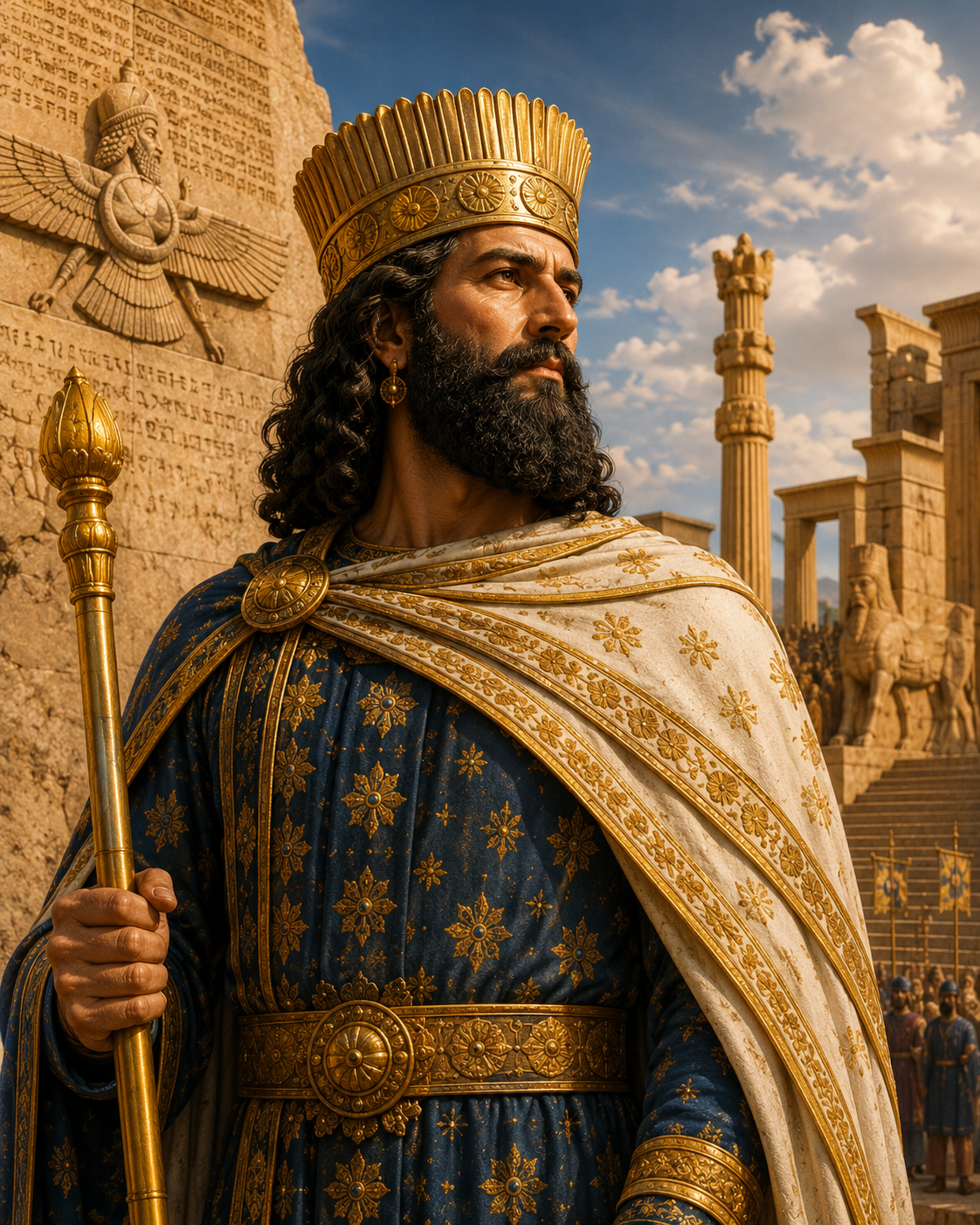
If Cyrus was the founder of the Achaemenid Empire, Darius became one of its greatest organizers. He strengthened its administration, improved communications, regularized taxation, and began construction of the magnificent complex that would become one of the enduring symbols of Iran: Persepolis.
A King in a Time of Crisis
After Cyrus died, his son Cambyses II became king and conquered Egypt. But his reign ended in political turmoil.
Darius came to power in 522 BCE.
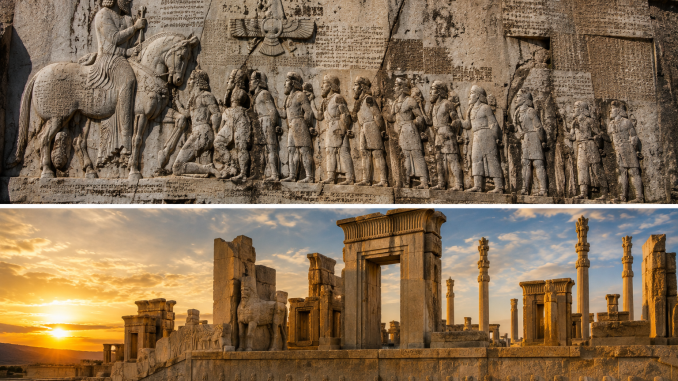
His version of these events was carved high upon the rock at Behistun, in present-day Kermanshah. The great inscription describes rebellions across the empire and Darius’s campaigns to restore royal authority.
The Behistun Inscription later became one of the most important documents for understanding the languages and history of the ancient Near East.
Darius had inherited an empire in crisis.
Before he could improve it, he first had to hold it together.
He succeeded.
Turning an Empire into a System
Darius understood that soldiers alone could not govern territories separated by thousands of miles.
An empire needed administration.
He strengthened the system of provinces commonly known as satrapies. Governors, or satraps, administered major regions and collected tribute, while royal officials and other mechanisms helped the king monitor provincial power.
One of the strengths of Achaemenid rule was its ability to combine central authority with local traditions.
The empire did not require every subject to become Persian. Different languages, religions, laws, and customs continued to exist within the same political structure.
This flexibility helped make government over an extraordinarily diverse population possible.
The Royal Road
Distance was one of the greatest challenges of the ancient world.
There were no telephones, trains, airplanes, or electronic communications. A message traveling from the western edge of the empire to the royal court could otherwise take an enormous amount of time.
The Achaemenids developed an extensive network of roads and relay stations. The most famous route became known as the Royal Road, connecting Sardis in Asia Minor with Susa and linking into a much wider imperial transportation system.
Stations along the route allowed royal couriers to obtain fresh horses and continue their journeys.
For its time, the system was remarkably efficient.
These roads also benefited merchants, travelers, administrators, and armies. Goods and information moved across the empire, helping distant provinces remain connected.
In a very real sense, roads became the threads holding the empire together.
Money, Taxes, and Administration
Darius also strengthened the economic organization of the empire.
The famous gold daric became closely associated with Achaemenid royal currency, alongside silver coinage. More regular systems of tribute and standardized measures helped support government and commerce across the empire.
Darius was not merely a warrior. He understood that power depended upon taxation, accounting, labor, resources, and reliable administration.
The clay tablets discovered at Persepolis offer a fascinating glimpse into this world.
They record rations, workers, journeys, livestock, agricultural products, and administrative transactions. Behind the magnificent palaces stood an enormous network of scribes, accountants, officials, laborers, and craftsmen.
An empire of stone also depended upon an empire of paperwork.
Persepolis: An Empire Carved in Stone
Around 518 BCE, Darius began a monumental building project in Fars at the foot of Kuh-e Rahmat.
Today we know it as Persepolis.
This was not simply another ordinary city. It became a royal and ceremonial complex designed to express the scale and order of the Achaemenid world.
Its enormous terraces, stairways, halls, columns, and reliefs created an architectural language of imperial power.
Yet perhaps the most fascinating feature of Persepolis is the way the empire’s peoples were represented.
The famous reliefs show delegations from different regions wearing distinctive clothing and carrying characteristic gifts. They are not all depicted as Persians. Their different appearances were deliberately preserved in stone.
The message was powerful: many peoples belonged to one imperial system.
Darius’s inscriptions similarly listed numerous lands under his authority and presented his kingship as sanctioned by Ahuramazda.
More than 2,500 years later, the surviving columns and reliefs still communicate something of the ambition behind this extraordinary project.
Darius in Egypt
Egypt was also part of Darius’s empire.
Rather than ignoring its ancient traditions, Darius presented his rule there within established Egyptian royal forms and supported important building activities.
His reign is also associated with work on a canal connecting the Nile region through Wadi Tumilat toward the Red Sea. Inscriptions connected with Darius survive along the ancient canal route.
Such projects reveal an important dimension of Achaemenid power.
Trade and communication mattered alongside military strength.
Connecting territories meant moving people, goods, messages, and resources efficiently across enormous distances.
The Greek Wars
Darius’s reign was not peaceful.
In the west, conflict with Greek city-states intensified after the Ionian Revolt. Eventually Persian forces crossed the Aegean, leading to the famous Battle of Marathon in 490 BCE, where the Persian expedition was defeated by the Athenians and their allies.
Marathon became one of the most celebrated battles in Western historical tradition.
But viewing Darius only through this defeat gives a distorted picture of his reign.
The Achaemenid Empire did not collapse after Marathon. It remained the dominant imperial power of the region.
Darius’s greatest legacy was not a single battlefield. It was the administrative structure that continued functioning long after his death.
The King Who Organized an Empire
Darius died in 486 BCE and was succeeded by his son Xerxes.
He left behind an empire far more organized than the one he had inherited.
Roads connected distant territories. Provincial governments administered vast regions. Financial systems supported the state. Susa had been transformed, and Persepolis was rising into one of the most magnificent architectural complexes of the ancient world.
Cyrus the Great had built the empire.
Darius gave it structure.
That distinction is central to understanding his place in Iranian history.
But the story of Persepolis has only begun.
In our next chapter, we will leave the kings for a moment and walk into the stone city itself—a place where stairways, columns, guards, craftsmen, and delegations from across the empire still tell their stories through stone.
Next Week: Persepolis — The City of Stone Built to Tell the Glory of Persia for Eternity.