
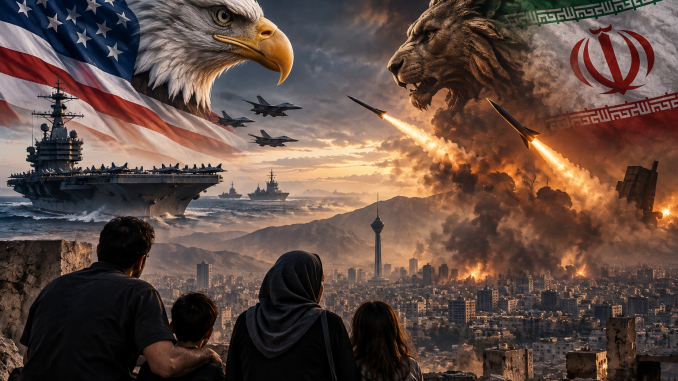
by Shahbod Noori
Sometimes, a short break gives us the strength to return with greater energy.
Last week, because of the Labor Day holiday, Tehran Weekly took a week off. For a weekly publication that has raced against deadlines for so many years, that brief pause gave our team a welcome opportunity to rest, recharge, and return with renewed energy to serve our readers and the Iranian community.
We sincerely thank you for your continued support, loyalty, and patience.
Unfortunately, while we rested, the world did not.
War continued. Threats continued. Sanctions continued. And ordinary people continued paying the price for decisions they had little or no role in making.
That brings us to a simple question:
When governments fight, why do the people always get the bill?
When we speak about Iran today, we hear enormous words: missiles, warships, sanctions, the Strait of Hormuz, oil, negotiations and military strategy.
But behind those words are millions of ordinary human beings.
A father trying to provide for his family.
A mother worried about the cost of medicine.
A young person wondering whether there will be a job or a future.
A shopkeeper whose customers can no longer afford to shop.
These people are not generals. They are not ministers or political leaders.
Yet they are usually the first to pay the price.
Iran possesses some of the greatest oil and natural-gas resources in the world. Its people should not have to struggle for fuel, electricity, medicine, food and other basic necessities.
Iran is not a poor country.
Iran is not poor. Iranians have been made poor.
There is an important difference.
Much of today’s crisis is the result of decades of disastrous policies by the Islamic Republic—corruption, mismanagement, regional adventurism, and placing ideology ahead of Iran’s national interests.
But we must also recognize another reality.
Economic pressure and war rarely hurt only governments.
When medicine becomes scarce or expensive, a patient in Tehran does not care about geopolitical strategy. That person simply wants to survive.
When a mother hears an explosion at night, she is not thinking about international relations.
She wants her child to wake up safely the next morning.
This is something easily forgotten in the noise of politics:
Iran is not its government.
Iran is its people.
It is our families and friends. It is children who know nothing about politics and young people who deserve to study, work, fall in love, travel, build careers and dream about their futures.
Opposing the Islamic Republic should never mean becoming indifferent to the suffering of the Iranian people.
In fact, it should mean exactly the opposite.
Those of us living outside Iran should also be careful not to watch war on television as though it were a sporting event.
A missile is not simply a number on a screen.
Behind every explosion there may be a human life.
Wars may produce winners among governments, military industries, political interests and those who profit from crisis.
For ordinary people, however, war usually has one great casualty:
Life itself.
Our hope should be for the end of the Islamic Republic and the beginning of a free, secular, prosperous Iran—an Iran whose government serves its people rather than demanding that its people serve the government.
But even on the road toward that future, we must remember that the goal is to save Iran and its people, not destroy the country we hope to free.
Politics can be complicated. There may be no easy answers.
But one truth remains painfully simple:
When governments go to war, ordinary people receive the bill.
The people of Iran have been paying that bill for more than four decades.
Perhaps instead of asking who will ultimately win this war, we should ask a different question:
How much longer must the Iranian people pay for it?
— Shahbod Noori
Editor-in-Chief
Tehran International Weekly Magazine