
By: Shahbod Noori
3/16/2026
breaking news
Nowruz, the ancient celebration inherited from our ancestors, is far more than the arrival of spring. It is a living symbol of Iranian identity. For thousands of years, this festival has represented the victory of light over darkness, hope over despair, and renewal over stagnation. Across centuries of hardship, invasions, and upheavals, Nowruz has endured—reminding us that the spirit of Iran can never be extinguished.
This year, however, Nowruz carries a different weight in our hearts. Many Iranians, both inside the country and across the world, are watching events unfold in Iran with deep concern and heavy emotions. The homeland we love faces uncertainty and suffering, and many families live with fear for the future.
Yet it is precisely in such moments that Nowruz reveals its deepest meaning.
Nowruz is a reminder that hope must never fade. It teaches us that even in the darkest winters, spring will eventually arrive. It reminds us that Iran is not merely a piece of land on a map—it is a civilization, a language, a culture, and a shared memory carried by millions of people around the world.
One of the strongest pillars of this identity is the Persian language. Persian is more than a means of communication; it is the vessel of our history and our soul. Through Persian, Ferdowsi preserved Iran’s ancient heritage in the Shahnameh. Through Persian, Saadi spoke of wisdom, justice, and humanity. Through Persian, Hafez captured the beauty and longing of the Iranian spirit.
In times like these, protecting and strengthening our language and culture becomes more important than ever.
This Nowruz can be an opportunity to reconnect with our roots. Let us speak more Persian with our children and grandchildren. Let us read Persian books, share Persian poetry, and keep the beauty of our language alive in our homes.
Opening a book by Saadi, Hafez, or Ferdowsi during Nowruz is not just a literary act—it is an act of cultural preservation. Ferdowsi himself wrote the Shahnameh over a thousand years ago to safeguard the Persian language at a time when it faced the danger of fading away. Today, every Persian book read, every Persian poem shared, continues that same mission.
Supporting Iranian culture also means supporting the institutions that keep it alive abroad. Iranian bookstores, Persian cultural centers, Iranian markets, restaurants, and community spaces are more than businesses. They are small islands of Iranian culture in foreign lands.
When we buy a Persian book, attend a cultural event, support an Iranian business, or read a Persian newspaper or magazine, we are doing more than making a purchase—we are helping keep Iranian culture alive for future generations.
But our responsibility does not stop there.
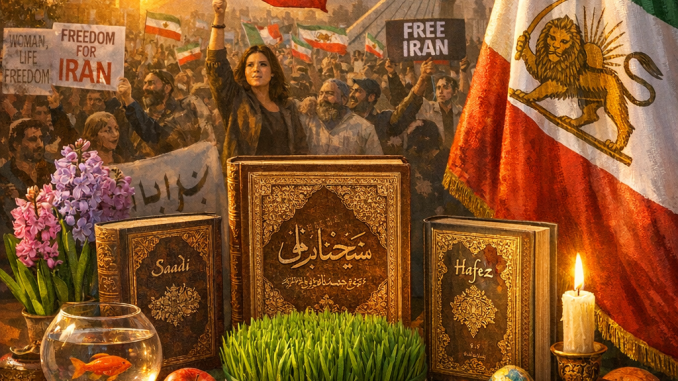
Many Iranians living outside the country feel a deep duty to be the voice of those who cannot freely speak inside Iran. Participating in demonstrations, civic gatherings, and public discussions about Iran is one way to ensure that the world does not forget the Iranian people.
Some may wonder whether one person’s presence can truly make a difference.
History shows us that great movements always begin with individuals who decide to stand up. Every voice raised, every flag lifted, and every person who shows up in solidarity sends a message to the world that the Iranian people are not alone and that their struggle is not forgotten.
Today, millions of Iranians live across Europe, North America, Australia, and beyond. Though we are scattered across continents, our hearts still beat for Iran.
Nowruz can become a moment of unity for this global Iranian community—a reminder that Iran lives not only within its borders, but in the hearts of every Iranian everywhere.
This year, let us prepare our Haft-Seen table with pride. Let the symbols of Nowruz—apples, wheat sprouts, garlic, vinegar, sumac, and sweet pudding—decorate our homes. Beside them, we can place the three-colored Iranian flag and a book of Persian literature.
These are not merely decorations; they are reminders of thousands of years of history and culture that belong to us all.
Nowruz teaches us one timeless truth: spring always returns.
No matter how long the winter, blossoms will eventually appear again. Iranian history has proven this many times. Iran has known long winters—but it has always found its way back to spring.
Today we may feel worry, sadness, or uncertainty. But hope remains alive.
Hope for a day when Iran will once again be peaceful, free, and flourishing. A day when Nowruz will be celebrated in the streets and homes of Iran with joy, safety, and dignity.
Until that day arrives, each of us carries a responsibility:
to protect our language,
to support our culture,
to stand beside one another,
and to ensure that the voice of Iran is heard around the world.
Nowruz is not only the beginning of a new year.
It is a reminder that Iran, like spring itself, will always rise again.
Happy Nowruz — and may Iran endure forever.