
by shahbod noori
ceo
06/29/2026
Every year, around July 1 (which corresponds to 10 Tir in the modern Iranian calendar), Iranians celebrate one of the oldest and most meaningful festivals of their ancient heritage: Tirgan. Rooted in the traditions of Zoroastrian Persia, Tirgan is far more than a religious observance. It is a celebration of rain, nature, friendship, sacrifice, and the enduring spirit of the Iranian people.
Alongside Nowruz, Mehregan, and Sadeh, Tirgan is considered one of the four great festivals of ancient Persia. Although thousands of years have passed since its origins, it continues to be celebrated by Zoroastrians and many Iranians around the world as a symbol of cultural identity and national pride.
The Zoroastrian Calendar
Ancient Persians developed one of the most sophisticated calendars of the ancient world. The Zoroastrian calendar consisted of twelve months, each containing thirty days, followed by five additional days at the end of the year to complete the 365-day solar cycle.
Unlike modern calendars, every month and every day had its own unique name. Most of these names were dedicated to divine beings known as Yazatas or Amesha Spentas, spiritual guardians representing virtues and elements of creation such as truth, water, earth, fire, plants, and humanity.
Whenever the name of a day matched the name of its month, Persians celebrated a festival. This tradition gave rise to many seasonal celebrations, including Tirgan.
The twelve months of the Zoroastrian calendar are:
- Farvardin
- Ordibehesht
- Khordad
- Tir
- Amordad
- Shahrivar
- Mehr
- Aban
- Azar
- Dey
- Bahman
- Esfand
Each month reflects an aspect of creation and the moral values that formed the foundation of ancient Persian civilization.
The Meaning of Tir
The fourth month of the year is called Tir. While the Persian word “tir” also means “arrow,” the month is actually named after Tishtrya (Tir), the celestial guardian associated with rain and fertility.
According to Zoroastrian belief, Tishtrya appears in the night sky as the brilliant star Sirius. He battles the forces of drought and darkness to bring rain to the earth. His victory ensures flowing rivers, fertile fields, healthy crops, and abundant life.
Because agriculture depended entirely on rainfall, water held a sacred place in ancient Persian culture. Tirgan therefore became both a thanksgiving celebration and a prayer for prosperity.
Why Tirgan Is Celebrated
The thirteenth day of every month in the Zoroastrian calendar is also named Tir. When the day of Tir falls within the month of Tir, the festival of Tirgan is observed.
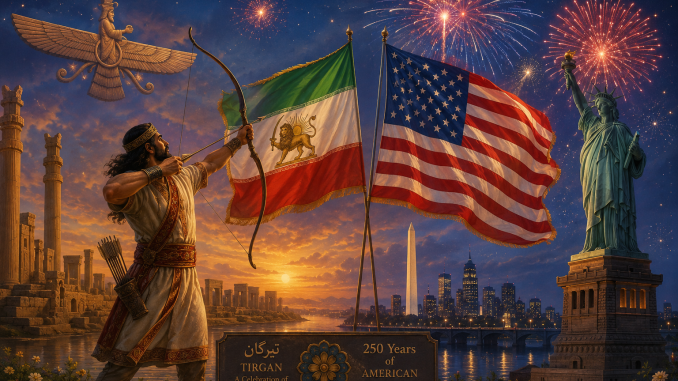
Over the centuries, Tirgan became associated with two of the most treasured traditions of Iranian culture: the victory of the rain-bringing deity Tishtrya over drought and the legendary story of Arash the Archer, one of Persia’s greatest national heroes.
Arash the Archer: The Hero Who Defined a Nation
Perhaps the most beloved legend connected with Tirgan is that of Arash the Archer.
According to ancient Persian mythology, after years of devastating war between Iran and Turan, both sides agreed to establish peace by determining a permanent border. The agreement was simple: an Iranian archer would fire a single arrow, and wherever it landed would become the new frontier between the two kingdoms.
Arash, the finest archer in Iran, accepted this impossible responsibility. He understood that the distance the arrow traveled would depend entirely on the strength and spirit he placed into the shot.
At dawn, Arash climbed to the summit of Mount Alborz. Gathering every ounce of his physical and spiritual strength, he released the arrow. It flew across mountains, forests, deserts, and rivers throughout the day before finally landing near the Oxus River (Amu Darya) at sunset.
The arrow’s extraordinary flight secured a vast territory for Iran and ended years of bloodshed.
However, Arash had given all of his life force to the arrow. As soon as it was released, he collapsed and died.
For generations, Arash has represented patriotism, courage, honesty, self-sacrifice, and the willingness to give everything for peace and one’s homeland. His story remains one of the greatest symbols of Iranian identity.
The Water Celebration
One of the most joyful Tirgan traditions is the custom of sprinkling water on family members and friends.
Because the festival honors rain and life-giving water, people traditionally gathered beside rivers, springs, and streams, playfully splashing one another with water while expressing hopes for abundant rainfall, successful harvests, and good fortune.
Today this tradition continues among many Zoroastrian communities and has become a cheerful reminder of nature’s essential role in human life.
The Seven-Colored Bracelet
Another beautiful Tirgan custom is the seven-colored bracelet, often called the “Tir and Wind” bracelet.
Participants tie colorful threads around their wrists during the festival and wear them for approximately ten days. They later remove the bracelet and tie it to the branch of a tree or release it into the wind while making a wish.
The bracelet symbolizes hope, renewal, friendship, and humanity’s connection with the natural world.
Water: A Sacred Gift
Unlike many ancient civilizations that celebrated military victories above all else, Persian civilization placed extraordinary importance on nature.
Water was viewed as sacred, and protecting rivers, springs, and underground qanats became both a practical necessity and a spiritual responsibility.
In today’s world, where climate change, drought, and water shortages affect millions of people, Tirgan’s message has become remarkably relevant. The festival reminds us that respecting natural resources is not merely an environmental concern—it is a moral obligation shared across generations.
Tirgan in the Modern World
Today Tirgan is celebrated by Zoroastrian communities in Iran, particularly in Yazd, Kerman, and Tehran, as well as by Iranian communities throughout North America, Europe, and Australia.
Families gather to share traditional meals, music, poetry, and prayers. Children learn about Persian history and mythology, while older generations pass on customs that have survived for thousands of years.
For members of the Iranian diaspora, Tirgan has become more than a seasonal celebration. It is an opportunity to preserve the Persian language, strengthen cultural identity, and introduce younger generations to the rich heritage of one of the world’s oldest civilizations.
A Living Legacy
Tirgan reminds us that Iran’s history is not defined solely by kings, empires, or wars. It is equally shaped by ideals of justice, generosity, environmental stewardship, and hope.
The legend of Arash teaches that true greatness is measured not by personal gain but by sacrifice for the common good. The festival’s traditions of water, friendship, and colorful bracelets celebrate unity rather than division and life rather than conflict.
Thousands of years after its beginnings, Tirgan continues to inspire Iranians everywhere. It stands as a timeless celebration of peace, resilience, gratitude, and the enduring cultural legacy of Persia.
Whether celebrated in Iran or by Iranian communities across the globe, Tirgan remains a powerful reminder that cultural traditions can survive centuries, connecting generations through shared history, enduring values, and hope for a brighter future.