
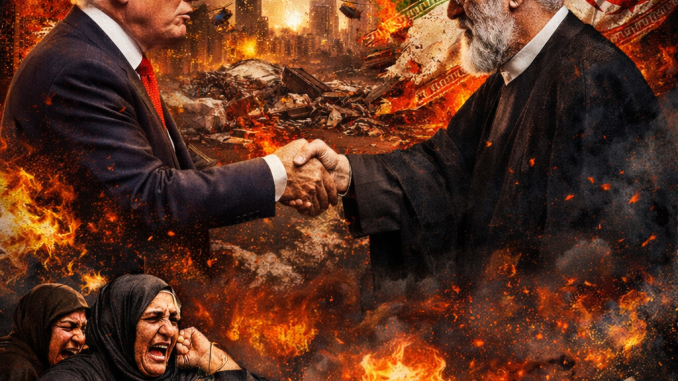
At a moment when Iran is engulfed in uncertainty, violence, and internal collapse, suddenly the language of “agreements,” “ceasefires,” and “de-escalation” is once again coming out of Washington. Words that may sound diplomatic on paper—but in reality, they carry the unmistakable scent of retreat.
A simple but critical question must be asked:
Who exactly is the United States negotiating with?
With a regime whose core leadership has been shattered?
With a power structure that appears fractured and unstable?
With a system where even insiders may not know who will be making decisions tomorrow?
When a country reaches this level of internal breakdown, any “agreement” is not a solution—it is a gamble. And a dangerous one.
What is being presented today as a “temporary ceasefire” looks far less like peace and far more like a strategic pause for the Islamic Republic to regroup—to rebuild, to tighten internal control, and ultimately to return to the same cycle of repression and confrontation. This is not speculation; it is a pattern repeated over decades.
And in all of this, one fundamental question remains unanswered:
Where are the people of Iran in these negotiations?
A nation that has endured years of economic pressure, political suppression, and now the looming shadow of war is once again being sidelined. Their future reduced to signatures behind closed doors. This is not diplomacy—it is exclusion.
Let’s be direct: agreements of this nature do not serve the Iranian people. They serve those who wish to preserve the status quo, even if that means prolonging the suffering of millions.
Which leads us to an uncomfortable but necessary possibility:
Is this push for compromise an indication that the United States has reached a strategic dead end?
Is this “de-escalation” in fact a quiet admission that it has failed to fundamentally change the situation?
If the objective was real change, then why ease pressure precisely at a moment when the internal structure appears weakened? Why move toward stabilization when instability might open the door to transformation?
This contradiction cannot be ignored.
History has shown us repeatedly: temporary ceasefires that are not rooted in reality and not aligned with the will of the people do not resolve conflicts—they merely delay them. And in Iran’s case, that delay may come at an even greater cost in the future.
Today, more than ever, the world must recognize a simple truth:
Iran is not just a geopolitical issue—it is a nation of people.
Negotiating with a regime that has lost legitimacy within its own borders does not bring peace. It does not create stability. It only buys time—for those unwilling to face reality.
And perhaps the most dangerous part of all this is when global powers choose to negotiate not with a nation, but with shadows of a collapsing structure.
This editorial is a warning:
Real peace cannot be built on fragile deals with unstable systems.
And if this truth continues to be ignored, the consequences will not remain confined to Iran—they will ripple across the entire region.