
Law for Everyone with Donya Noori
8/31/2026
By Donya Noori
Graduate of Southwestern Law School and Legal Professional with the Law Offices of Camellia Jalilvand
After a car accident, one of the first questions everyone asks is: “Who was at fault?”
But the answer is not always one person.
Sometimes another driver made a serious mistake, but you may also have done something that contributed to the collision. Perhaps another vehicle suddenly changed lanes, but you were traveling somewhat faster than was safe. Maybe someone turned in front of you, but you were distracted for a moment and did not react as quickly as you normally would.
Many people assume that if they were even slightly responsible for an accident, they automatically lose the right to recover compensation.
In California, however, the law does not necessarily work that way.
What Is Comparative Negligence?
California follows a legal principle commonly known as pure comparative negligence.
In simple terms, responsibility for an accident can be divided among the people involved.
For example, after reviewing the evidence, it might be determined that Driver A was 80 percent responsible for the collision while Driver B was 20 percent responsible.
Being partially responsible does not necessarily eliminate Driver B’s ability to recover damages. Instead, that person’s percentage of responsibility may reduce the amount of compensation available.
A Simple Example
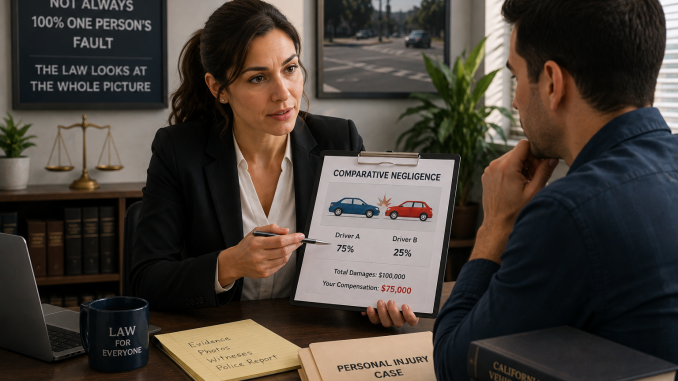
Suppose the damages that may otherwise be recoverable in an accident are valued at $100,000.
After reviewing the case, it is determined that the other driver was 75 percent responsible for causing the collision and you were 25 percent responsible.
In a simplified example, your 25 percent share of responsibility could reduce the $100,000 recovery by 25 percent, leaving $75,000.
Real cases can be considerably more complicated, but this example illustrates the basic concept.
Who Decides the Percentage of Fault?
This is one of the most important questions in any disputed accident.
The other driver saying, “It was your fault,” does not establish legal responsibility.
Insurance companies may take positions regarding fault based on the information available to them. If the parties continue to disagree and the matter proceeds through litigation, responsibility can ultimately be determined based on the evidence by a judge or jury.
Police reports, photographs, video recordings, witness statements, vehicle damage, traffic laws, and sometimes expert analysis may all become important.
Don’t Immediately Say, “It Was My Fault”
Accidents are stressful. People may be frightened, confused, or simply trying to be polite.
Someone might immediately say:
“I’m sorry. I think it was my fault.”
But that person may not yet know the entire story.
Hours later, surveillance footage might show that the other vehicle entered the intersection against a red light or was traveling at an unsafe speed.
After an accident, exchange the necessary information, check whether anyone needs medical assistance, cooperate with law enforcement, and truthfully describe what you observed.
But avoid making conclusions about legal responsibility before all the facts are known.
What If the Police Report Says You Were at Fault?
A police report can be an important piece of evidence, but it is not necessarily the only evidence that matters.
Additional information may later become available.
A nearby business may have surveillance footage. Another driver may have recorded the collision with a dash camera. An independent witness may come forward.
This is why preserving evidence immediately after an accident can be so important.
Dash Cameras Can Be Valuable
When two drivers give completely different versions of an accident, dash-camera footage may provide extremely useful evidence.
A recording might show the color of a traffic signal, an unsafe lane change, the movement of the vehicles, or other details that are difficult to reconstruct later.
If your vehicle has a dash camera, make sure the relevant recording is preserved after an accident before the system automatically records over it.
Independent Witnesses Matter
If someone saw the accident, obtain that person’s contact information whenever possible.
An independent witness may be able to explain which vehicle entered the intersection first, whether someone made an unsafe turn, or what occurred during the seconds immediately before impact.
A few minutes spent obtaining witness information at the scene can become extremely valuable weeks or months later.
If You Made a Mistake, Don’t Lie About It
Being careful about admitting legal fault is very different from being dishonest.
If you were using your phone, speeding, or doing something else that may have contributed to the collision, providing false information can seriously damage your credibility.
Honesty is extremely important in a personal injury matter.
The purpose of comparative negligence is not to hide anyone’s mistakes. It is to determine, based on the evidence, how much each person’s conduct contributed to the accident.
Why the Percentage Matters
When your percentage of responsibility can directly affect the amount of compensation you may recover, disagreements about fault can become extremely important.
One side may argue that you were only 10 percent responsible, while another may claim you were 50 percent responsible.
That difference can have a significant financial impact.
This is why photographs, videos, witness statements, police reports, and other evidence can become so valuable.
Accidents Are Not Always Black and White
Some collisions have an obvious cause. Many others result from a combination of mistakes.
One driver may make an unsafe lane change while another is traveling too fast. Someone may fail to yield while the other driver is distracted and fails to react in time.
The law can consider the conduct of everyone involved.
This is an important point for California drivers to understand: if you believe you may have contributed to an accident, do not automatically assume that you have lost all of your rights.
What Should You Do After the Accident?
Instead of arguing at the scene about who was responsible, concentrate on preserving facts.
Take photographs of the vehicles and accident scene. Obtain witness information. Preserve dash-camera footage. Report the accident when appropriate, and if you are injured, take your medical condition seriously.
Also avoid making impulsive statements on social media about who caused the accident.
Responsibility should be determined from evidence—not from something said or posted while you were frightened, angry, or in shock.
Final Thoughts
One of the biggest mistakes an accident victim can make is assuming:
“I may have been partly responsible, so there is nothing I can do.”
Under California’s comparative negligence system, responsibility can be divided between the people involved, and a person’s percentage of fault may affect the amount of compensation that can be recovered.
Therefore, even if you believe you made a mistake, it is important to understand the complete circumstances before reaching conclusions about your legal rights.
A traffic accident is not always a story of one careful driver and one careless driver. Sometimes two mistakes occur within seconds of each other and create an accident that affects people’s lives for months or even years.
Understanding the law helps separate a person’s immediate feeling of guilt from the legal determination of responsibility.
About the Author
Donya Noori is a graduate of Southwestern Law School and works with the Law Offices of Camellia Jalilvand in Los Angeles. Her professional experience focuses primarily on automobile accident and personal injury matters.
This article is provided for educational and informational purposes only and should not be considered legal advice for any specific situation.
If you have questions regarding an automobile accident or personal injury matter, you may contact the Law Offices of Camellia Jalilvand and request to speak with Donya Noori.