
IRAN: The Eternal Land
Before the name of Cyrus the Great echoed across the ancient world, and before the Achaemenid Empire stretched from Central Asia toward the Mediterranean, a people living among the mountains of western Iran were beginning one of the most important chapters in the history of the Iranian Plateau.
They were the Medes.
Their story is not simply about the rise of a king or victory in battle. It is the story of scattered communities that gradually developed into a political and military power capable of confronting one of the most feared empires of the ancient world.
A People of the Mountains
During the early first millennium BCE, Iranian-speaking peoples became increasingly prominent across parts of the Iranian Plateau. Among them were the Medes, who established themselves primarily in western and northwestern Iran, especially around the Zagros Mountains.
Their homeland contained fertile valleys, open plains, and high mountains. Life could be difficult, but the mountains also provided natural protection.
The Medes practiced agriculture and animal husbandry and became particularly associated with horses. In the ancient world, horses represented far more than transportation. They were essential to military power, communication, and wealth.
At first, however, the Medes were not united under a single centralized state. Different communities had their own local leaders.
Then came a powerful reason for unity: Assyria.
Under the Shadow of Assyria
For centuries, the Assyrian Empire dominated much of the ancient Near East. Its highly organized armies and aggressive campaigns made it one of the most formidable military powers of its age.
Assyrian forces repeatedly entered the Zagros region, demanding tribute and attacking communities that resisted their authority.
For separate Median groups, confronting such an empire was extremely difficult. The pressure from Assyria may have been one of the forces that encouraged greater political cooperation among the Medes.
History often shows that a common threat can bring divided peoples together.
The Medes were beginning to discover the strength of unity.
Deioces: Between History and Legend
The Greek historian Herodotus tells the story of a man named Deioces, whom he describes as the first king of the Medes.
According to Herodotus, Deioces initially became respected because of his reputation for fairness and justice. Eventually, the people selected him as their ruler.
Modern historians debate how literally this account should be accepted. The early political development of the Medes remains difficult to reconstruct, and Herodotus wrote long after the events he described.
Still, the story reflects an important historical transformation: Median society was moving from scattered tribal leadership toward more organized political authority.
Associated with this period is a city that would remain important throughout Iranian history:
Ecbatana, known today as Hamadan.
Ecbatana became closely connected with Median royal power and later continued to serve important functions under subsequent Iranian dynasties.
From Vulnerability to Power
One of the most important Median rulers was Cyaxares.
Ancient traditions credit him with strengthening and reorganizing the Median military. Under his leadership, the Medes emerged as a major regional force.
The balance of power was beginning to change.
Assyria, which had once sent armies into Median territory, was itself becoming vulnerable.
The Medes eventually joined forces with the Babylonians against their common enemy. In 612 BCE, their armies captured Nineveh, the great Assyrian capital.
The fall of Nineveh was one of the defining events of ancient Near Eastern history.
An empire that had dominated the region for generations collapsed.
The Medes were no longer simply mountain peoples defending their homeland. They had become one of the major political powers of their time.
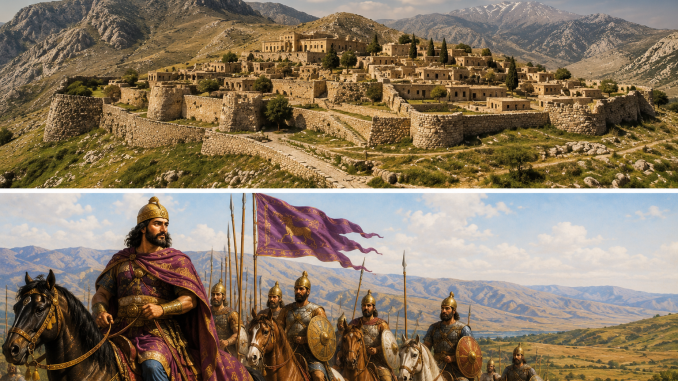
Ecbatana: The Heart of Media
Ancient writers described Ecbatana as an impressive royal city. Herodotus famously wrote of multiple defensive walls surrounding it, although archaeology has not confirmed every detail of his account.
What is beyond doubt is the historical importance of the city and its region.
Situated near Mount Alvand, with access to water, fertile land, and major routes across western Iran, Ecbatana occupied an ideal location for an important political center.
Imagine a caravan approaching the city more than 2,500 years ago.
Horses move across the surrounding plains. Merchants arrive carrying goods from distant lands. Soldiers guard roads leading toward the settlement, while farmers work the fertile valleys beyond.
In such a place, an idea larger than loyalty to a single tribe was taking shape.
Were the Medes Iran’s First State?
The Medes are sometimes described as founders of the first Iranian state. That statement requires some qualification.
Civilizations such as Elam had ruled parts of present-day Iran thousands of years earlier. The importance of the Medes lies instead in their position as one of the earliest major Iranian-speaking political powers to establish authority across a significant part of western Iran.
In this sense, the Median period represents the beginning of a new historical chapter.
The political world that developed under the Medes would soon become part of something much larger.
The Last King and the Rise of Cyrus
After Cyaxares came Astyages, the final Median king.
But to the south, another Iranian people—the Persians—were becoming increasingly powerful.
Their leader was a man whose name would soon become known throughout the ancient world:
Cyrus.
Around 550 BCE, Cyrus rebelled against Astyages. The Median king was defeated, and political power passed to Cyrus.
Yet the Medes did not simply disappear.
Cyrus incorporated important Median elites and traditions into his new kingdom. Medes and Persians would serve together within the Achaemenid Empire, and foreign sources sometimes referred to them together as “the Medes and Persians.”
What happened was therefore more than the destruction of one civilization by another. It was also a transfer and expansion of political power.
The Bridge to the Persian Empire
If Elam represented one of the ancient foundations of civilization on the Iranian Plateau, the Medes became a bridge between that older world and the great Iranian empires that followed.
They demonstrated the power of political unity and emerged as significant participants in the struggles that reshaped the ancient Near East.
But an even greater chapter was about to begin.
From Persia had risen a leader whose ambitions would reach far beyond the boundaries of Media. He would unite territories, defeat powerful kingdoms, and establish an empire unlike anything the region had previously seen.
His name was Cyrus the Great.
And his extraordinary story will be the next chapter of Iran: The Eternal Land.