
By: Fatmeh Pouresmaeil
03/16/2026
How Ancient Sacred Texts Placed Iran at the Center of History—and Possibly the Future
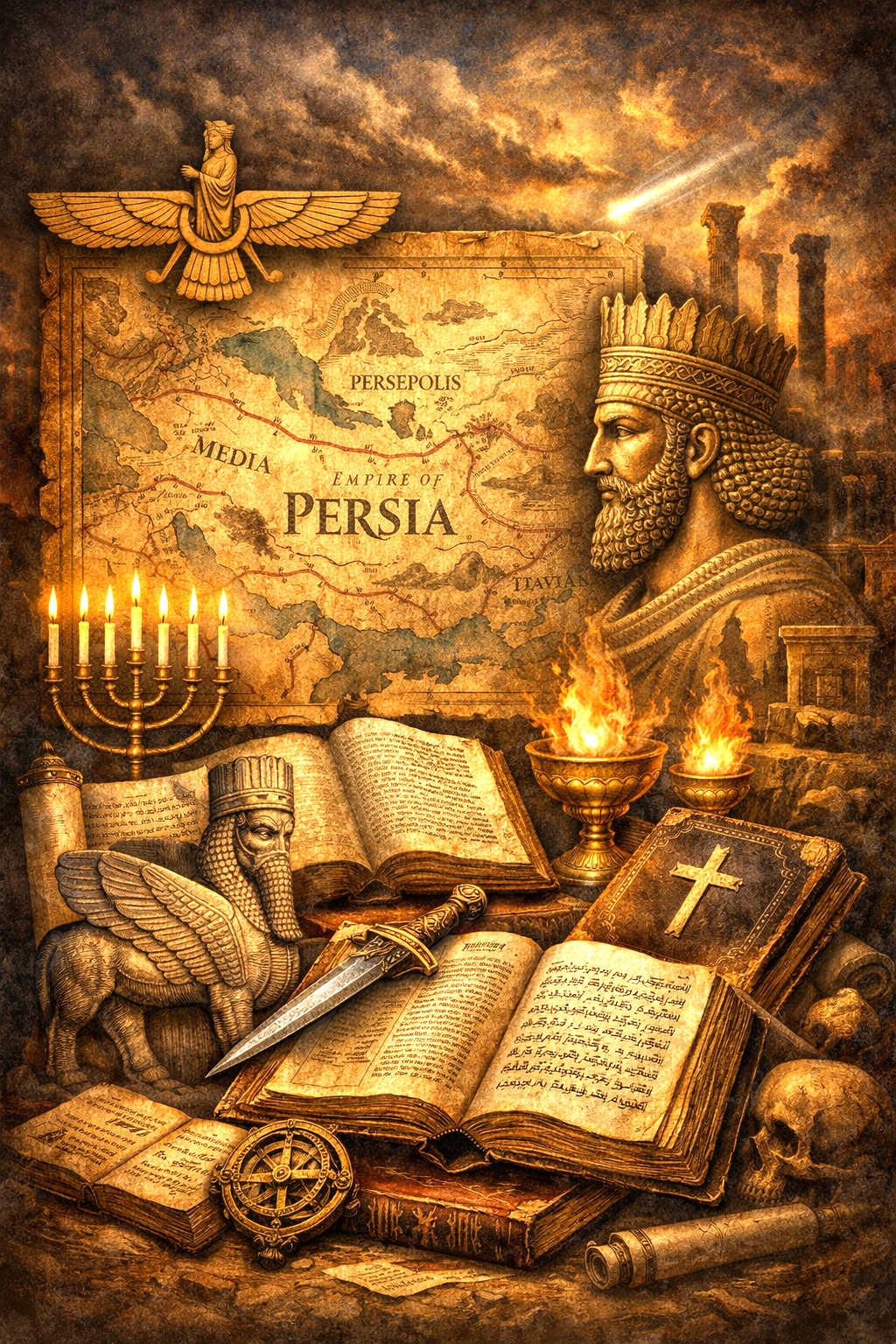
There are few nations in the world whose names echo not only through history books, but through the pages of sacred scripture.
Persia—modern-day Iran—is one of them.
Long before modern geopolitics, before oil, revolutions, and headlines, Persia was already being written about in texts that billions of people would one day consider holy. In those texts, it is not just a land. It is a force. A presence. A turning point.
What makes this even more fascinating is that Persia does not appear in just one tradition—but across multiple religious worlds: Jewish, Christian, and Zoroastrian.
And in some of those writings, Persia is not just remembered.
It is anticipated.
A Civilization That Entered Scripture
To understand why Persia appears in sacred texts, you have to understand one thing:
this was not just another empire.
At its height, ancient Persia controlled one of the largest empires the world had ever seen—stretching from the edges of India to the gates of Egypt. It was not only powerful, but unusually organized, culturally flexible, and deeply influential.
For the people living under its rule—or even near it—Persia was unavoidable. It shaped trade, law, religion, and daily life. So when ancient writers documented the world around them, Persia naturally found its way into their words.
But what stands out is not just that Persia was mentioned—
it’s how it was described.
Persia as a Symbol of Order and Power
In several ancient writings, Persia is portrayed not as chaos—but as structure.
This is a subtle but important distinction.
Where other empires are often described as destructive or oppressive, Persia in many accounts is associated with administration, stability, and transition. It appears as a force that doesn’t just conquer—but reorganizes.
Some scholars believe this reflects the Persian approach to governance. Unlike many conquerors, Persian rulers often allowed local traditions, religions, and cultures to continue. This created an image—whether fully accurate or not—of an empire that brought a different kind of rule.
Over time, this image evolved. Persia became more than a political entity.
It became a symbolic power within the storytelling of ancient civilizations.
The East as a Source of Wisdom
In early religious thought, the East was often associated with knowledge, mystery, and deeper understanding of the universe.
And Persia stood at the heart of that perception.
Ancient observers saw Persian scholars studying the stars, measuring time, interpreting signs, and developing systems of thought that connected the physical world with something beyond it.
This gave rise to a powerful idea:
that wisdom did not come from the center of empires—but from the edges, from the East.
In this context, Persia was not just a place—it was a direction, a source of insight.
Even centuries later, this association remained. The East—and by extension Persia—continued to represent hidden knowledge, cosmic awareness, and spiritual depth.
The Idea of a Final Turning Point
One of the most striking overlaps between different religious traditions is the concept of a final transformation of the world.
A moment when history changes direction.
In Zoroastrian thought, this idea is especially clear. The world is seen as a battleground between opposing forces, moving toward a final resolution where truth overcomes deception and light defeats darkness.
What’s remarkable is that similar ideas later appear in other traditions as well.
Some researchers believe that the intellectual environment of ancient Persia may have influenced how neighboring cultures began to think about time—not as a cycle, but as a story moving toward an ending.
In that sense, Persia was not just part of history.
It may have helped shape how humanity understands the future itself.
Persia in the Language of Prophecy
In certain texts, references to Persia appear in passages that are often interpreted as prophetic or symbolic.
These references are rarely simple. They do not read like straightforward historical records. Instead, they appear in visions, allegories, and layered narratives.
Because of this, they have been interpreted in many different ways across centuries.
Some readers see them as reflections of past events.
Others view them as timeless patterns that repeat in different eras.
And then there are those who believe these passages point to something more—
that they are fragments of a larger, unfinished story.
Regardless of interpretation, one thing is clear:
Persia is not absent from these narratives.
It is present—and often positioned at key moments.
A Crossroads of Civilizations
Geographically, Persia sat at one of the most important crossroads in the ancient world.
Trade routes passed through it. Ideas moved across it. Religions interacted within it.
This meant that Persia was constantly exposed to different ways of thinking—and in turn, influenced them.
It became a meeting point where:
Eastern philosophies encountered Western traditions
Religious ideas were exchanged and reshaped
Cultural identities blended and evolved
Because of this, Persia did not just exist within one narrative—it became part of many narratives at once.
And those narratives eventually found their way into sacred texts.
Why Persia Still Feels Relevant Today
What makes all of this more than just history is the fact that Persia—now Iran—remains at the center of global attention.
It continues to be a focal point of political tension, cultural identity, and regional influence.
For some observers, this creates an eerie sense of continuity.
A feeling that the same land described thousands of years ago is still playing a role in the unfolding story of the world.
Of course, modern reality is complex and shaped by countless factors.
But the symbolic weight of Persia—its presence in ancient texts, its historical depth, its cultural influence—adds another layer to how it is perceived today.
It is not just a country in the news.
It is a country with a narrative that stretches back millennia.
Between Myth, Memory, and Meaning
So how should we understand these ancient references to Persia?
Are they literal predictions?
Historical reflections?
Symbolic storytelling?
The answer may depend on perspective.
For historians, they are windows into how ancient people understood power and geography.
For theologians, they are part of a larger spiritual framework.
For readers, they are something else entirely—
a reminder that some places carry more than just borders.
They carry meaning.
A Name That Endures
Across centuries, empires have risen and fallen. Borders have changed. Names have disappeared.
But Persia—by any name—has endured.
Not just on maps, but in memory.
Not just in history, but in belief.
And perhaps that is what makes it unique.
Because while many nations are remembered,
few are written into the language of prophecy, philosophy, and faith.
Persia is one of them.