
The United States has lost one of its most prominent and influential political figures. Senator Lindsey Graham, the longtime Republican senator from South Carolina and a leading voice on American foreign policy, died on July 11, 2026, at the age of 71 following a sudden illness.
His death shocked Washington and prompted expressions of sorrow from political leaders in the United States and around the world. Graham had served in the U.S. Senate since 2003 after previously representing South Carolina in the House of Representatives. He was also a U.S. Air Force veteran, an attorney and one of the best-known supporters of a strong American role in international affairs.
For many Iranians, however, Lindsey Graham will also be remembered as one of the American political leaders who repeatedly distinguished between the Iranian people and the Islamic Republic governing them.
Throughout the years, Graham strongly opposed the policies and actions of the Islamic Republic while expressing support for the Iranian people’s desire for freedom, democracy, dignity and a government of their own choosing.
At a time when many international officials remained silent or hesitant, Graham frequently spoke publicly about the courage of Iranian women, young people and political prisoners. He called upon the United States and other democratic nations to stand with the people of Iran rather than accommodate a government accused of repression, terrorism and regional aggression.
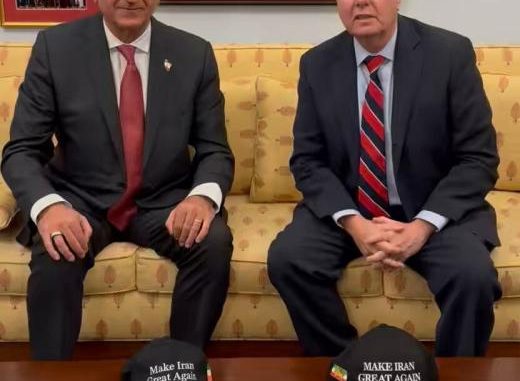
One of the most memorable images for Iranian-Americans was Graham’s appearance alongside Crown Prince Reza Pahlavi and his public embrace of Iran’s historic Lion and Sun flag. For many Iranians, the moment carried meaning far beyond an ordinary political event. It represented recognition of Iran’s national identity and solidarity with a people seeking to reclaim their country and their future.
Crown Prince Reza Pahlavi described Graham following his death as a steadfast friend of the Iranian people and a proud defender of freedom. He said the senator had stood beside Iranians in their struggle against tyranny at moments when friends were difficult to find.
Graham’s approach to Iran was sometimes forceful and controversial. He consistently favored severe pressure against the Islamic Republic, supported stronger economic sanctions and repeatedly warned about Tehran’s nuclear and military ambitions. His critics viewed him as overly willing to use American military power, while his supporters considered him one of the few politicians who clearly understood the threat posed by authoritarian regimes.
Regardless of political disagreements surrounding his broader career, his support for the Iranian people earned him respect among many members of the Iranian diaspora.
Graham also became one of President Donald Trump’s closest congressional allies, particularly on national security, Iran, Israel, Ukraine and the Middle East. Although the two men had serious differences during the 2016 presidential campaign, Graham later became one of Trump’s most recognizable defenders and foreign-policy advisers.
He was known in Washington as a tireless legislator who remained deeply involved in international affairs until the final days of his life. Shortly before his death, he was still working on legislation aimed at imposing greater pressure on countries purchasing Russian oil and supporting Moscow’s war against Ukraine.
The passing of Lindsey Graham leaves a significant vacancy in the United States Senate and removes one of Washington’s most experienced foreign-policy voices. South Carolina’s governor is expected to appoint a temporary successor until the seat can be filled through the appropriate electoral process.
For the Iranian-American community, his death is also the loss of a political figure who repeatedly used his position to keep the struggle of the Iranian people visible in Washington.
He did not confuse Iran with the Islamic Republic. He understood that Iran is an ancient nation with a proud culture and a population deserving of freedom, peace and opportunity.
His political career was complex, and historians will undoubtedly debate many of his positions. Yet many Iranians will remember the moments when he stood beside them, raised his voice on their behalf and held the Lion and Sun flag as a symbol of solidarity with their hopes.
Tehran International Weekly Magazine extends its condolences to Senator Graham’s family, friends, colleagues and the people of South Carolina.
His voice may now be silent, but his support for the Iranian people and their struggle for freedom will not be forgotten.