
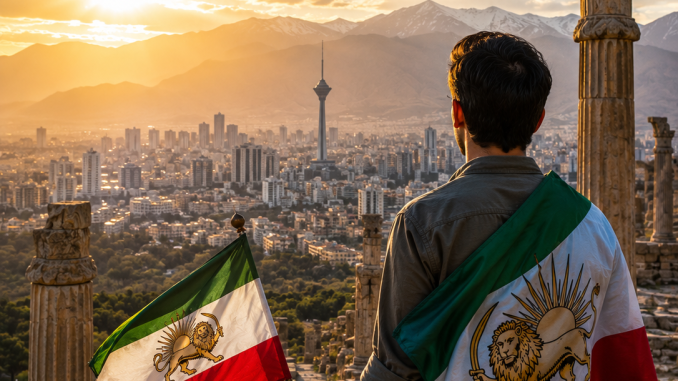
Whenever Iran faces war, protests, executions, economic hardship, or any major national crisis, millions of Iranians around the world suddenly turn their attention back to their homeland. Social media fills with the Iranian flag, patriotic songs are shared, and images of Tehran, Shiraz, Isfahan, and other cities circulate everywhere. Once again, the world hears the voices of Iranians expressing their love for their country and their concern for its people.
But only a few weeks later, when the headlines fade and the sounds of conflict become quieter, many of us return to our daily routines—as though Iran exists only during moments of tragedy.
This is not written to criticize Iranians living abroad. Many left their homeland with nothing but hope. They worked hard, learned new languages, built careers, raised families, and created successful lives in their adopted countries. They deserve the security, peace, and opportunities they have earned.
Yet one important question remains:
Is our responsibility toward Iran limited to sharing a photograph, posting a slogan, or attending a demonstration whenever a crisis erupts?
Iran is far more than a place on the map.
Iran is our language.
It is our history.
It is our literature, music, traditions, and identity.
If we preserve this connection only during times of war and political turmoil, it will slowly disappear.
The first generation of immigrants still becomes emotional when hearing an old Persian song or smelling the aroma of traditional Iranian food. A familiar street in Tehran or a photograph of the Alborz Mountains can instantly bring back memories.
But what about the second and third generations?
Will our children still speak Persian?
Will they know that Nowruz represents thousands of years of civilization rather than simply a beautiful holiday celebration?
Will they understand why Ferdowsi, Hafez, Saadi, Khayyam, Cyrus the Great, and so many others remain symbols of our national identity?
Will they know where their parents came from—and why so many were forced to leave?
No government can erase a nation as effectively as forgetfulness can.
Books may be censored.
History may be rewritten.
Monuments may be destroyed.
But as long as a people preserve their language, culture, and collective memory, that nation continues to live.
The responsibility of Iranians living abroad extends far beyond political activism.
Supporting an independent Persian-language publication helps preserve Iran’s voice.
Supporting an Iranian-owned business strengthens our community.
Teaching our children Persian builds a bridge between generations.
Supporting Iranian artists, writers, musicians, and cultural organizations keeps our heritage alive.
Unfortunately, our community sometimes spends more energy criticizing one another than supporting one another.
Success is too often met with jealousy instead of pride.
Political disagreements become personal conflicts.
Different opinions become permanent divisions.
Yet if we cannot stand together outside Iran, how can we hope to rebuild Iran itself one day?
The Iranian diaspora possesses extraordinary talent and influence. Around the world, Iranian doctors, engineers, entrepreneurs, professors, journalists, scientists, artists, and business leaders have earned respect through hard work and excellence.
Imagine what could be achieved if even a fraction of that knowledge, experience, and generosity were directed toward preserving our culture and preparing for Iran’s future.
Love for Iran cannot be measured only during moments of crisis.
It must become a daily commitment.
Let us not remember Iran only when missiles are launched.
Let us not wave the Iranian flag only when the world is watching.
Let us not rediscover our identity only when tragedy dominates the headlines.
Iran also needs us during peaceful times.
It needs us to preserve our language.
To strengthen our cultural institutions.
To support independent media.
To encourage the next generation to remain connected to its roots.
Many of us may never return to live permanently in Iran.
Our children may spend their lives in America, Canada, Europe, or Australia.
But being Iranian is not defined by where we live.
It is defined by what we carry within us.
Our homeland is not merely the soil we left behind.
It is a responsibility we carry every day—and one we must pass on to future generations with dignity, pride, and hope.
Let us not love Iran only during times of crisis.
Let us honor Iran every day through our actions, our choices, and our commitment to one another.
Because if we forget Iran, we should not expect the rest of the world to remember it.
— Shahbod Noori
Editor-in-Chief
Tehran International Weekly Magazine