
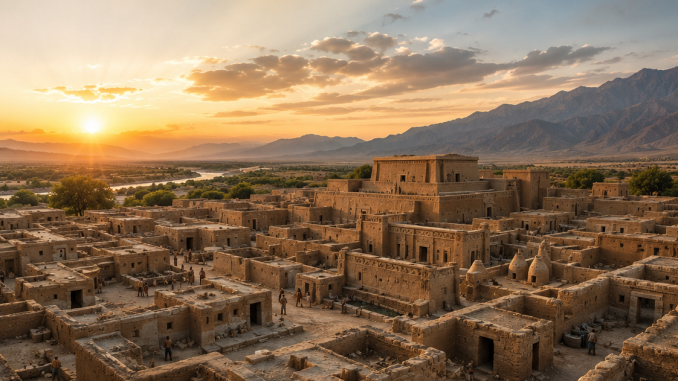
Part Three: Shahr-e Sukhteh — The City That Spoke Again from Beneath the Earth
In a remote corner of Sistan, among scorching sunlight, desert winds, and a landscape that now seems silent and still, lie the remains of a city that was once one of the most important centers of life in eastern Iran. Today, we call it Shahr-e Sukhteh, or the Burnt City. Yet this name alone cannot fully describe the energy, creativity, and organized life that existed there thousands of years ago.
Shahr-e Sukhteh is more than a collection of ruined walls and broken pottery. It is a living record of a time when intelligent, disciplined, and hardworking people built an advanced community in the difficult natural environment of Sistan.
The city was founded around 3200 BCE and remained inhabited, through several major phases, until about 1800 BCE. It stood along important Bronze Age trade routes and included separate residential, industrial, public, and burial areas. This organization points to a complex and carefully structured society in the eastern Iranian Plateau.
More than five thousand years ago, when many parts of the world had not yet developed large urban communities, the people of Shahr-e Sukhteh were building homes, producing goods, trading with distant regions, and creating order within their society.
The city was located near the historic course of the Helmand River. At that time, the surrounding environment was different from what we see today. Access to water and suitable land supported farming, animal husbandry, and long-term settlement.
Still, life in the region was never easy.
The inhabitants had to deal with changing weather, limited natural resources, and the constant challenges of a dry landscape. Instead of surrendering to those conditions, they learned how to manage their environment and adapt to it.
The structure of the city reveals that different areas had different purposes. Residential neighborhoods were separated from industrial zones, while the cemetery occupied its own distinct area. Such planning shows that the people of Shahr-e Sukhteh were concerned not only with constructing houses, but also with organizing public space and daily activity.
Homes were built mainly from mud brick, a practical material well suited to the climate. Some buildings contained several rooms, suggesting that families lived in relatively organized households. Fireplaces, pottery, tools, and traces of food have helped archaeologists reconstruct parts of everyday life.
A typical morning in Shahr-e Sukhteh may have begun with food preparation, care for livestock, and work in nearby workshops. Children may have played in dusty lanes while adults worked as farmers, weavers, potters, builders, or craftspeople. Merchants prepared for long journeys, while artisans shaped materials into objects for daily use or trade.
One of the most remarkable features of the city was the variety of its industries and arts. Craftspeople worked with decorative stones, copper, wood, bone, and other materials. Archaeological discoveries show that they were highly skilled in producing beads, jewelry, tools, pottery, and carved objects.
Lapis lazuli, turquoise, agate, and quartz were shaped and polished in the city. Copperworking was also widespread. By the middle of the third millennium BCE, Shahr-e Sukhteh may have been one of the largest settlements in the eastern Iranian Plateau, with several specialized industries operating at the same time.
The presence of materials brought from distant regions proves that the city was connected to the wider ancient world. Shahr-e Sukhteh likely stood as an important link between the Iranian Plateau, Central Asia, Afghanistan, Baluchistan, and lands farther east.
Caravans carried more than merchandise. They also transported ideas, news, technologies, artistic styles, and new methods of production. In this way, the city became a meeting point where different cultures could influence one another.
Among the objects discovered at Shahr-e Sukhteh, several have attracted worldwide attention.
One of the most famous is a painted pottery cup decorated with a sequence of images showing a goat moving toward a tree. When viewed in order, the images create the impression of movement. For this reason, the vessel is sometimes described as one of the earliest known examples of sequential animation.
Archaeologists also discovered the remains of a woman whose eye socket contained an artificial eye. This object is often identified as one of the oldest known artificial eyes in history. Whatever ceremonial, cosmetic, or social purpose it may have served, the discovery demonstrates impressive technical skill and close attention to appearance.
Studies of human remains from the site have also revealed valuable information about disease, nutrition, physical labor, and the general health of the population. Some evidence has been interpreted as showing forms of medical care or surgical intervention. Such claims, however, must be treated carefully, because every archaeological discovery requires scientific examination and cautious interpretation.
The enormous cemetery of Shahr-e Sukhteh is one of the most important parts of the site. Thousands of graves once existed there, and burial practices provide insight into the beliefs, customs, and social differences of the community.
Pottery, tools, beads, and personal belongings were placed beside some of the dead. Perhaps the people believed that these objects would be useful after death. They may also have represented respect, affection, wealth, occupation, or social status.
Yet one great question remains: why did such an important city disappear?
Shahr-e Sukhteh experienced several fires during its long history, but fire alone was probably not responsible for its final decline. Environmental changes, shrinking water supplies, shifts in the course of nearby rivers, and increasingly difficult living conditions may all have contributed to the abandonment of the city.
It is unlikely that Shahr-e Sukhteh vanished in a single dramatic event.
The decline may have happened slowly. Families may have realized that survival was becoming more difficult and gradually moved away. Workshops that had once echoed with tools, voices, and daily activity fell silent.
The streets emptied. Mud-brick walls collapsed. Wind and sand slowly covered the homes and memories of the people who had lived there.
Centuries passed before archaeologists began to uncover the site again. Large-scale scientific excavations started in the twentieth century, first involving Italian teams and later continuing under Iranian researchers. In 2014, Shahr-e Sukhteh was officially added to the UNESCO World Heritage List.
The importance of the Burnt City lies not only in its age.
It proves that the civilization of Iran had deep and widespread roots long before the rise of the great Persian empires. Before Cyrus, Darius, and Persepolis, people in eastern Iran were already building cities, developing industries, managing trade, and creating organized communities.
We do not know the names of most of these people. We do not know exactly what language they spoke or what they called their city.
But the work of their hands remains.
A small pottery vessel.
A carved bead.
A mud-brick wall.
A grave that preserved its secrets for thousands of years.
Shahr-e Sukhteh is therefore not simply a burnt city. It is a city whose memory survived beneath the earth.
Every piece of pottery brought back into the light seems to carry a message from five thousand years ago: before history recorded the names of kings, ordinary people had already begun building civilization on the Iranian Plateau.
In the next part of our journey, we will explore another of Iran’s most mysterious ancient cultures: Jiroft, a civilization whose discovery changed the way scholars view the origins of urban life and art in the Iranian Plateau.