
By: Shahbod Noori
08/24/2026
Not Entirely Here, Not Entirely There — Yet Belonging to Both
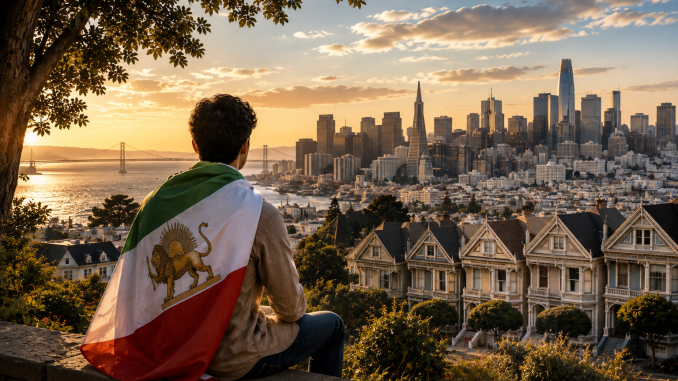
Years ago, when many Iranians packed their belongings and left for the United States, Canada, Europe, and other parts of the world, they probably never imagined that one day they would have children who would know Iran mostly through their parents’ stories, family photographs, music, food, Nowruz celebrations, and the memories of grandparents.
Today, those children have grown up and formed a new generation of Iranians—a generation raised in a different society, educated in another language, yet carrying part of its identity from a country where many of them have never lived.
What should we call this generation? Iranian? American? Iranian-American?
Perhaps the simplest answer is: both.
One mistake the first generation of immigrants sometimes makes is expecting their children to have exactly the same relationship with Iran and Iranian culture that they themselves have. But how can we expect someone born in Los Angeles, New York, Toronto, London, or another Western city to carry the same memories as parents who spent their childhood and youth in Tehran, Shiraz, Tabriz, Isfahan, Mashhad, or another Iranian city?
For the first generation, Iran is made up of real memories: the street where they grew up, the school they attended, their grandmother’s home, the smell of their mother’s cooking, Nowruz vacations, childhood friends, and thousands of small moments that eventually become part of a person’s identity.
For many of our children, however, Iran is more of an inheritance than a memory.
And that difference is neither their failure nor ours.
Children raised outside Iran often live between two worlds. At home, they may encounter traditional Iranian values, while outside the home they grow up in a culture that places greater emphasis on individual independence, personal choice, and a different approach to social relationships.
This difference can sometimes create misunderstandings between parents and children.
A parent may say, “When we were your age, we never did that.”
The child could reasonably answer, “But I didn’t grow up in the same world you did.”
Perhaps both are right.
The problem begins when, instead of understanding those differences, one generation tries to turn the other into a copy of itself.
Language is one of the clearest examples. Many Iranian parents become disappointed when their children cannot speak Persian fluently, mix English words into their conversations, or cannot read the poetry of Hafez and Saadi.
That concern is understandable. Language is one of the most important ways culture survives, and losing it can make communication between generations more difficult.
But if a young person does not speak perfect Persian, does that make him or her less Iranian?
I don’t believe it does.
Identity is much greater than language alone. A young person may speak Persian with an accent but still look forward to Nowruz, enjoy Iranian music, love Persian food, take pride in Iran’s history, and feel something deeply personal whenever the name Iran is mentioned.
Instead of criticizing this generation, perhaps we should find better ways to make Iran and Iranian culture meaningful and attractive to them.
Culture cannot be successfully passed to the next generation through force.
If we want our children to know the Shahnameh, we should make its stories fascinating to them. If we want them to preserve Nowruz, we should make Nowruz a joyful memory. If we want them to speak Persian, we should not embarrass them every time they make a mistake.
A culture passed down with love is far more likely to survive. A culture associated only with pressure and obligation may be abandoned at the first opportunity.
There is another side to this story as well. Second-generation Iranians should understand that growing up with two cultures is not a weakness. It can be an extraordinary advantage.
An Iranian-American can combine some of the best qualities of both worlds: from Iranian culture, the importance of family, hospitality, respect for elders, literature, art, and thousands of years of history; and from the society in which they were raised, independence, confidence, civic participation, teamwork, and tremendous educational and professional opportunities.
That combination can create an exceptionally strong generation.
Today, we see the children of Iranian immigrants succeeding in universities, hospitals, technology companies, courtrooms, media, the arts, sports, business, and many other important areas of society. Some may not speak Persian as fluently as their parents, but their accomplishments are still part of the Iranian immigrant story.
Every time a young Iranian-American succeeds in medicine, science, law, business, art, or public service, that person also carries a small part of the community from which his or her family came.
This generation can become an important bridge between Iran and the rest of the world.
For decades, the image of Iran presented internationally has too often been dominated by politics, conflict, war, and crisis. But Iran is much more than politics.
Iran is Hafez, Saadi, and Ferdowsi. It is Persepolis and the architecture of Isfahan. It is music, cinema, food, art, hospitality, and thousands of years of civilization.
Who is better positioned to introduce that Iran to the world than young Iranians who understand both cultures?
But if we want that to happen, the Iranian community must also make room for them.
If our cultural events are designed only for the first generation, if Persian-language media makes little effort to connect with younger audiences, and if our community gatherings are attended almost exclusively by those who immigrated thirty or forty years ago, we should not be surprised when younger generations gradually move away.
Preserving the Iranian community cannot simply mean preserving the past. We must also make room for its future.
Perhaps we need to listen more carefully to our young people. What interests them? What concerns them? How do they see Iran? What would make them want to remain connected to the Iranian community?
The first generation also possesses something enormously valuable that should not disappear: experience.
The generation that immigrated often had to rebuild life from the beginning. Many arrived with university degrees but limited English. They worked, established businesses, raised families, sent their children to universities, and built communities that are now recognizable parts of the social and economic landscape of cities such as Los Angeles.
That story deserves to be told to the next generation—not so they will feel indebted, but so they understand how the road they walk today was built.
At the same time, the first generation must accept that their children are not supposed to become another version of themselves.
They have their own world, their own challenges, and ultimately their own identities.
Perhaps the future of the Iranian diaspora will be created precisely at this intersection: between past and future, Iran and America, Persian and English, tradition and modern life.
We should not ask our children to choose one world and reject the other. We should help them take the best from both.
Being Iranian is not simply a matter of birthplace. It is not only about language, nor is it simply about having an Iranian name. Identity is a combination of history, family, culture, memory, and belonging—and it can take many different forms while remaining authentic.
One day, the first generation of Iranian immigrants will no longer be here, and much of the responsibility for preserving Iranian culture abroad will fall upon the same young people whose accented Persian may concern us today.
Instead of worrying about them, we should prepare them.
Not through pressure, but through affection.
Not through criticism, but through pride.
And not by asking, “How Iranian are you?” but by reminding them:
You can be Iranian and belong fully to the country where you were born. One identity does not have to erase the other.
If the first generation represents the roots and the second generation represents the branches, then a tree growing between two cultures does not have to become weaker. It can grow wider, stronger, and reach farther.
Perhaps the greatest inheritance immigrants can leave their children is not a house, a bank account, or material possessions. It is an identity they can be proud of, along with the freedom to carry that identity forward in their own way.
When that happens, immigration will not have marked the end of a culture.
It will have become the beginning of a new chapter in the same story.