

Nowruz is far more than the beginning of a calendar year. For Iranians, it represents continuity, identity, and resilience.
Throughout history Iran has endured wars, invasions, and political upheavals. Empires have risen and fallen. Governments have changed. Yet one tradition has remained constant: Nowruz.
From the Achaemenid Empire to the present day, the Persian New Year has continued to return every spring, reminding the Iranian people that even the darkest winter eventually gives way to light.
Today, as many Iranians face uncertainty and hardship both inside Iran and across the diaspora, Nowruz carries an even deeper meaning. It reminds us of a timeless truth:
No winter lasts forever. Spring always returns.
Nowruz in Ancient Persia


Historical research shows that Nowruz was the most important national celebration of ancient Persia. During the Achaemenid era, kings and representatives from across the vast empire gathered at Persepolis to celebrate the arrival of the new year.
The famous reliefs carved into the walls of Persepolis depict delegations from different nations bringing gifts to mark the spring festival. These scenes symbolize unity, prosperity, and peace among the diverse peoples of the empire.
In the ancient Zoroastrian worldview, Nowruz marked the victory of light over darkness and the renewal of the natural world. It was a moment when humanity was reminded to live in harmony with nature and with one another.
During these early celebrations, sacred Zoroastrian texts and symbols of nature were placed on ceremonial tables as part of the festival traditions.
Thus Nowruz began as a deeply Iranian cultural celebration, rooted in the ancient spiritual and philosophical traditions of Persia.
The Haft-Seen Table: Symbol of Persian Identity


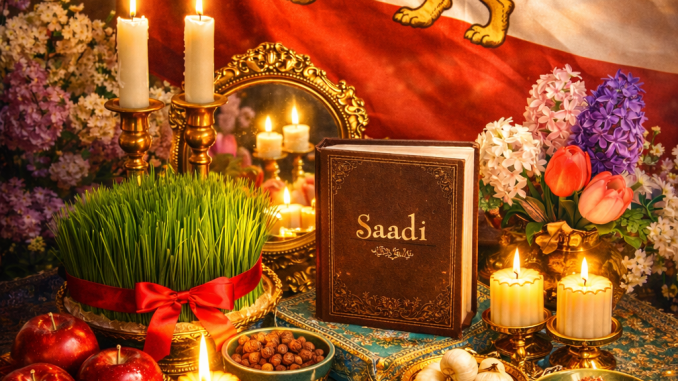
At the heart of the Nowruz celebration is the Haft-Seen table, a symbolic arrangement of seven items beginning with the Persian letter “S.” Each element represents an aspect of life and renewal.
The traditional items include:
• Sabzeh (sprouts) – rebirth and renewal
• Seeb (apple) – beauty and health
• Samanu – strength and abundance
• Senjed – love and wisdom
• Seer (garlic) – protection and medicine
• Serkeh (vinegar) – patience and experience
• Somāq (sumac) – the rising sun and a new day
Alongside these symbolic foods, many families also place cultural and decorative items such as:
• A mirror
• Candles
• Painted eggs
• Hyacinth flowers
• Coins for prosperity
For many Iranians today, especially in the diaspora, the historic Lion and Sun flag of Iran has also become a powerful symbol to place beside the Haft-Seen. It represents national heritage, history, and the enduring spirit of the Iranian people.
Another meaningful addition is the book of Saadi, one of the greatest poets in Persian literature. Saadi’s message of human unity continues to resonate across centuries.
His famous lines, engraved at the entrance of the United Nations, capture the spirit of humanity:
Human beings are members of a whole,
In creation of one essence and soul.
Nowruz During Difficult Times
History shows that Iranians have never abandoned Nowruz, even in the most difficult moments.
The festival survived the Mongol invasions, political turmoil, revolutions, and wars. Even in times when authorities attempted to diminish or suppress ancient traditions, the Iranian people continued to celebrate the arrival of spring.
Why?
Because Nowruz is more than a celebration. It is a declaration of cultural survival.
When families gather around the Haft-Seen table during challenging times, they are making a quiet yet powerful statement:
We are still here.
Our culture is still alive.
Iran is still alive.
Nowruz and the Iranian Diaspora
Today millions of Iranians live outside their homeland. Yet wherever they go, Nowruz travels with them.
In cities like Los Angeles, Toronto, London, and Berlin, Persian communities celebrate the New Year with gatherings, music, traditional food, and beautifully arranged Haft-Seen tables.
For many Iranian families abroad, Nowruz is a bridge between generations. It allows younger generations to connect with their heritage while reminding older generations that their culture remains alive and vibrant.
Nowruz also sends a message to the world:
Iranian civilization is far older and deeper than any government or political moment.
How to Celebrate Nowruz with Pride Today
In times of uncertainty, traditions like Nowruz become even more meaningful. There are many ways to honor the spirit of the Persian New Year:
Prepare a Haft-Seen table
Even a simple arrangement keeps the tradition alive.
Display symbols of Iranian heritage
The Lion and Sun flag and Persian cultural elements remind us of our shared identity.
Read Persian poetry
Books by Saadi, Hafez, or Ferdowsi connect the present to centuries of Persian wisdom.
Gather with friends and family
Nowruz has always been a time of reconciliation, love, and community.
Teach the younger generation
Children should know that Nowruz is not just a holiday—it is part of a 3,000-year-old cultural legacy.
Nowruz Always Triumphs
When we look at the long arc of Iranian history, one truth becomes clear:
Nowruz has never been defeated.
Empires have disappeared.
Wars have ended.
Political systems have changed.
But every year, the first day of spring arrives—and with it, Nowruz returns.
For this reason many Iranians say:
Nowruz is the celebration of hope over despair.
Even during difficult times, the message of Nowruz remains timeless:
Spring is coming.
Life will renew itself.
And the spirit of Iran will endure.