
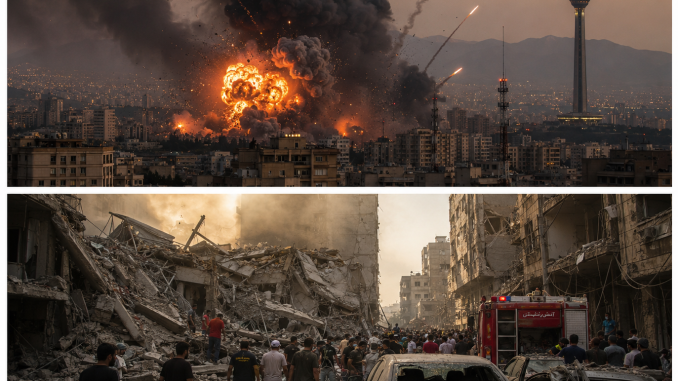
From last Monday through today, the war between Iran and the United States has entered a more dangerous and far-reaching phase. The conflict is no longer limited to missile sites, military bases, or naval vessels. During seven consecutive nights of U.S. operations, bridges, railway lines, airports, power facilities, communications networks, and infrastructure connected to water distribution in southern Iran have also been targeted.
In response, the Islamic Republic has expanded its missile and drone attacks against neighboring countries that host American forces.
As always, ordinary people are carrying the heaviest burden of the war. They had no role in deciding to begin the conflict, yet many are now unable to leave dangerous areas. Power and water outages, disruptions to transportation, closed roads, fuel shortages, and constant fear of further bombardment have severely affected the daily lives of thousands of Iranian families.
Seven Consecutive Nights of U.S. Strikes
The United States Central Command announced that American forces completed their seventh consecutive night of strikes against targets inside Iran by Friday evening. According to CENTCOM, the operations involved fighter aircraft, combat drones, warships, and precision-guided weapons.
The strikes reportedly targeted surveillance and tracking systems, military logistics infrastructure, underground weapons storage facilities, and Iranian naval capabilities.
The United States says the main purpose of the attacks is to reduce the Islamic Republic’s ability to threaten commercial shipping and disrupt traffic through the Strait of Hormuz.
At the same time, President Trump’s administration has reimposed a naval blockade around Iranian ports. Washington has warned that ships refusing to follow U.S. military instructions could be stopped, inspected, or forced to change course.
Reports from inside Iran, however, indicate that the attacks have expanded beyond strictly military facilities and have also damaged parts of the country’s public infrastructure.
Hormozgan and Bandar Abbas at the Center of the Attacks
Hormozgan Province has suffered some of the heaviest attacks in recent days. Bandar Abbas is home to Iran’s largest commercial port, major naval installations, Revolutionary Guard facilities, and coastal surveillance centers, making it one of the main targets of U.S. operations.
Recent strikes have reportedly hit command centers, air-defense systems, missile and drone facilities, and coastal surveillance equipment in Bandar Abbas and nearby islands.
The United States has also reported attacks on cruise-missile facilities and coastal defense positions on Greater Tunb Island.
Several important bridges around Bandar Abbas have reportedly been struck as well. From a military perspective, these attacks appear intended to disrupt the movement of weapons, equipment, and personnel between southern ports, naval bases, and Revolutionary Guard installations.
For civilians, however, the destruction of bridges has also disrupted transportation, food deliveries, fuel distribution, emergency services, and access to surrounding communities.
In Bandar Khamir, an attack on a bridge caused a major fire and reportedly killed at least seven people, according to Iranian state television.
There have also been reports of damage to railway lines and transportation routes across southern Iran.
Qeshm, Iranshahr, and Chabahar
Qeshm Island has also been targeted in several waves of attacks. Coastal surveillance facilities, communications centers, and positions described by the United States as connected to Revolutionary Guard naval operations have reportedly been bombed.
In Iranshahr, in Sistan and Baluchestan Province, a military base was struck. The Iranian military announced that seven service members were killed in one of the attacks.
Iranshahr Airport was also reportedly among the targets, and its operations were disrupted.
Strikes have also been reported around Chabahar. However, the Indian government stated that the terminal operated by India at Chabahar Port was not damaged and remained operational.
This suggests that at least part of the port complex has so far escaped direct destruction.
Bushehr and Central Areas of Iran
Several explosions have also been reported in Bushehr. The city is home to naval installations as well as Iran’s only operating nuclear power plant.
Although explosions were heard in the area, no credible report has yet confirmed damage to the main nuclear power plant complex.
Official and media reports suggest that U.S. attacks are gradually expanding from Iran’s southern coastline toward more central regions.
Communications towers, transportation centers, bridges, and military logistics facilities have reportedly been among the latest targets.
Human Casualties and Water and Power Disruptions
Iran’s Health Ministry has announced that approximately 50 people have been killed and more than 500 injured in the latest wave of U.S. attacks.
The figures may include both military personnel and civilians, and no detailed breakdown of all victims has yet been released.
Earlier reports had placed the number of deaths at 38 and the number of injured at more than 400, but the casualty count has risen as the attacks have continued.
Women and at least one child have reportedly been among the victims.
In Hormozgan Province, damage to power and water infrastructure has caused outages and reduced water service in several villages and urban areas.
Communications networks have also been disrupted, while residents in southern Iran have reported electricity cuts, water shortages, and difficulty finding gasoline.
Strikes against infrastructure with both military and civilian functions have raised serious humanitarian concerns.
Iran’s Response: Attacks on Neighboring Countries
In response to U.S. strikes, the Islamic Republic has launched waves of missiles and drones toward neighboring countries.
Tehran claims that the targets are American military facilities and bases involved in operations against Iran. However, some attacks have also damaged airports, refineries, power stations, water facilities, and civilian areas.
Kuwait, Bahrain, Jordan, and Saudi Arabia have all been targeted in recent days.
Air-defense systems have also been activated in Qatar and other Persian Gulf states.
Heavy Damage to Kuwait’s Water Facilities
One of Iran’s most serious attacks in the region reportedly struck a major power-generation and desalination complex in Kuwait.
The attack caused a fire and damaged facilities responsible for producing a significant share of the country’s drinking water.
More than 90 percent of Kuwait’s drinking water comes from desalination plants, meaning that serious damage to such a facility could directly affect millions of people.
Kuwaiti authorities asked the public to conserve water and electricity.
Several workers and emergency personnel were also reportedly injured during the attacks and firefighting operations.
Kuwait’s airport and some oil facilities were targeted in separate waves of attacks.
Flights were temporarily disrupted, while the country’s air defenses intercepted a number of incoming missiles and drones.
Attacks on Bahrain, Jordan, and Saudi Arabia
In Bahrain, warning sirens were activated and defense forces reported intercepting several airborne threats.
The Islamic Republic claimed that it had targeted U.S. military facilities and a technology and artificial-intelligence center linked to military activities.
The exact extent of the damage remains unclear.
Jordan was also targeted by missiles and drones aimed at locations Iran described as logistical centers supporting American operations.
The Jordanian government said that some of the attacks were intercepted.
The Islamic Republic also claimed to have struck a base connected to U.S. operations in Jordan, although that claim has not been independently verified.
Saudi Arabia was also directly targeted for the first time in several months.
Prince Sultan Air Base near Al-Kharj, where American forces are stationed, was reportedly among the intended targets.
Defense alerts were activated in Al-Kharj and near the strategic port city of Yanbu.
Complete and independently verified information about possible damage or casualties has not yet been released.
The Strait of Hormuz: A Threat to the Global Economy
Alongside the air and ground attacks, the Strait of Hormuz has become the most dangerous area of confrontation.
Iran has reportedly attacked or detained several commercial vessels, while the United States has stopped or inspected ships that Washington says were attempting to break the blockade of Iranian ports.
According to the U.S. military, nearly a dozen civilians have been killed, injured, or reported missing in recent attacks on commercial vessels.
Explosions and possible mine incidents have also been reported near shipping routes, while tanker traffic through the strait has dropped sharply.
The Strait of Hormuz is one of the world’s most important energy corridors, carrying a significant share of global oil and gas supplies.
The disruption has pushed oil prices higher and increased concerns about gasoline prices, energy shortages, and broader global inflation.
Civilians Trapped Between Two Fires
The developments of this week show that the Iran–U.S. war is moving beyond what could be described as a limited military confrontation.
It is increasingly becoming a war against infrastructure that civilians depend on every day.
Attacks on bridges, power stations, airports, ports, and water facilities directly threaten ordinary people, regardless of the military justification behind them.
The United States says it is trying to destroy the Islamic Republic’s military capacity and prevent threats to international shipping.
The Islamic Republic, meanwhile, describes its attacks on neighboring countries as retaliation against states hosting U.S. forces.
But the citizens of those neighboring countries had no role in starting the war.
Iran now faces damaged infrastructure, a growing number of casualties, water and electricity shortages in the south, and the possibility that attacks may spread to additional cities.
At the same time, Iranian attacks on Kuwait, Bahrain, Jordan, and Saudi Arabia have increased the risk of transforming the conflict into a full-scale regional war.
The most alarming development is the gradual crossing of previously accepted red lines.
Every time a power plant, desalination facility, bridge, airport, or commercial ship is attacked, the boundary between military warfare and harm to civilian society becomes less clear.
If the conflict continues in this direction, it will threaten not only Iran’s future but also the security of the entire Middle East and the stability of the global economy.
The people of Iran, who have already endured years of economic, political, and social pressure, are now facing a war with no clear or guaranteed end.
Without an immediate reduction in attacks, a return to negotiations, and a credible mechanism to protect shipping through the Strait of Hormuz, each new night may bring more destruction, more displacement, and more victims.