
by: Shahbod Noori
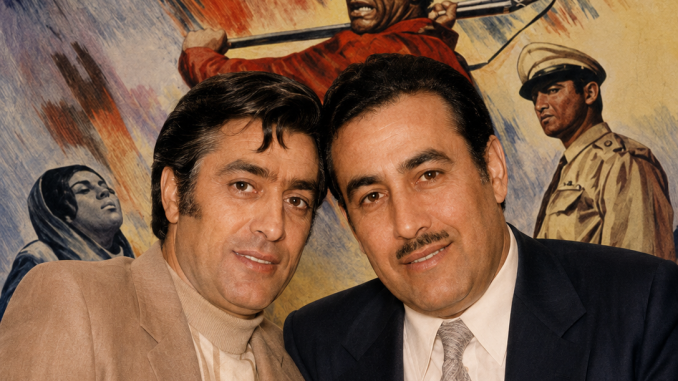
Sometimes in the history of entertainment, two artists come together so naturally that, decades later, it becomes almost impossible for audiences to separate one from the other.
In Iranian cinema, Mohammad Ali Fardin and Iraj Khajeh Amiri created exactly that kind of partnership.
One stood in front of the camera. He smiled, fought, fell in love, defended the weak, protected his friends and became the romantic hero of millions.
The other stood behind a microphone.
And when Fardin opened his mouth to sing, it was often Iraj’s powerful voice that filled the movie theater.
Together, they created something larger than either cinema or music. They created memories.
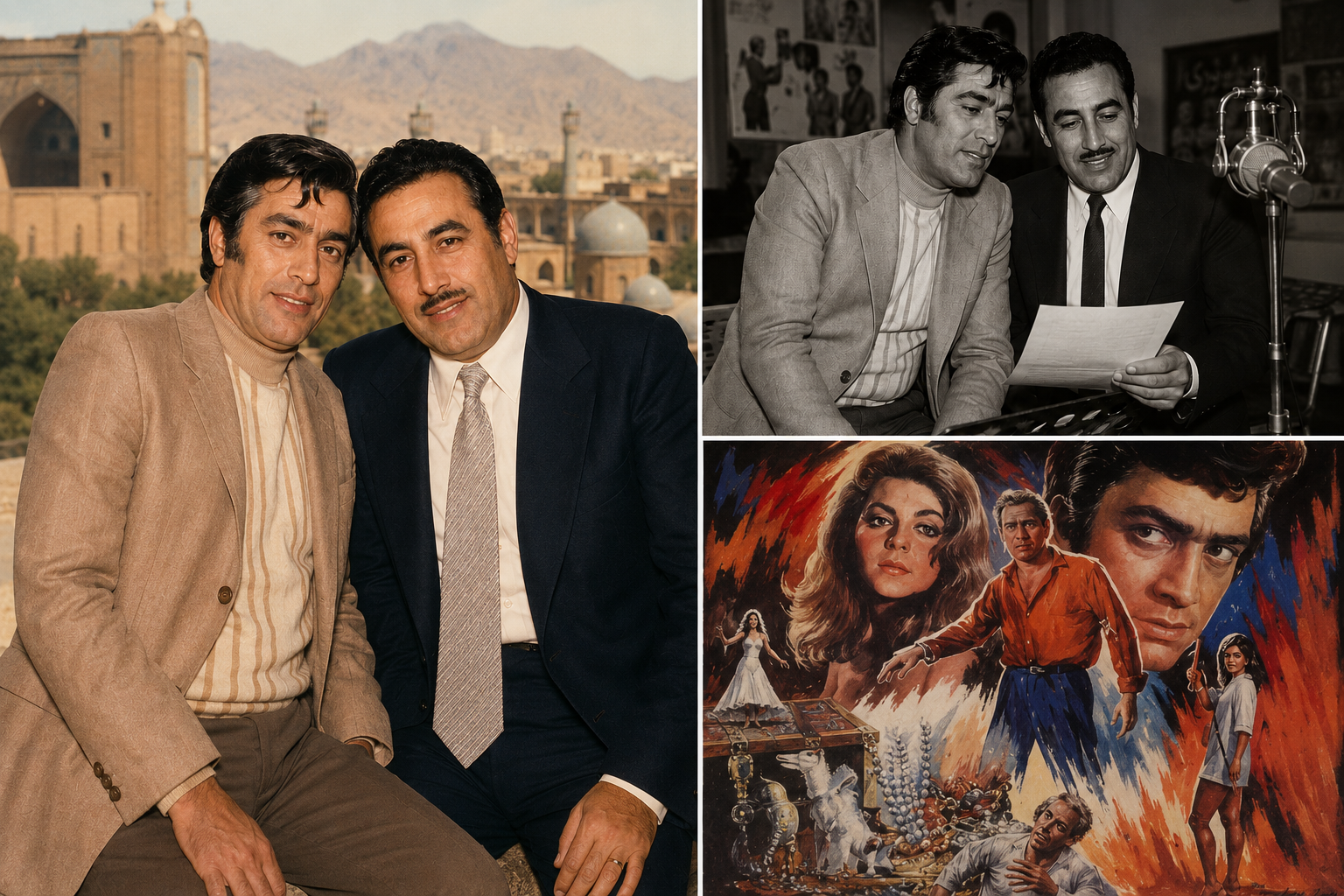
With the passing of Iraj, Iran has lost one of the most recognizable voices of its modern musical history. Yet remembering him does not have to be a sad journey. His remarkable career offers an opportunity to return to a colorful period of Iranian popular culture—a time of crowded movie theaters, enormous hand-painted posters, unforgettable songs and stars whose names were known in virtually every Iranian household.
And among the most memorable stories from that era is the story of Fardin and Iraj: one face, one voice and a friendship between cinema and music that lasted far beyond the films themselves.
A Star on the Screen, a Voice Behind It
For younger generations, it may be difficult to imagine how important cinema once was in everyday Iranian life.
There was no internet, no streaming, no social media and certainly no hundreds of television channels competing for attention.
Going to the movies was an event.
Families planned for it. Young couples went on dates to the cinema. Friends stood in long lines outside theaters. Giant colorful posters covered the entrances, and photographs of movie stars appeared in magazines and shop windows.
Among all those stars, Mohammad Ali Fardin occupied a unique position.
Before becoming an actor, Fardin had been an accomplished wrestler. His athletic appearance, handsome face, easy smile and natural charisma helped transform him into perhaps the most recognizable male star of Iranian popular cinema.
But his appeal went beyond appearance.
The typical Fardin character represented an ideal that audiences immediately understood: the honorable man.
He could be tough without being cruel, romantic without appearing weak, and emotional without losing his masculinity. He stood by his friends, respected family, defended those who had been mistreated and usually found himself caught somewhere between love, poverty, wealth, friendship and destiny.
And naturally, sooner or later, Fardin would sing.
Except the magnificent voice coming from the screen was frequently not Fardin’s own.
It belonged to Iraj.
The Voice That Seemed to Belong to Fardin
Iraj—born Hossein Khajeh Amiri—possessed one of the most distinctive male voices in Iranian music.
His voice had extraordinary strength and range, but perhaps more importantly for cinema, it had personality.
There was confidence in it.
There was masculinity, warmth and emotion.
It could carry a serious traditional Persian vocal performance, yet it could also become accessible enough for a song heard by thousands of ordinary moviegoers.
This made Iraj particularly well suited to Fardin’s screen personality.
After audiences repeatedly heard Iraj’s voice coming from Fardin’s image, something fascinating happened.
The two gradually became connected in the public imagination.
Fardin would appear on screen, begin moving his lips, and Iraj’s voice would emerge.
It somehow felt completely natural.
Iraj himself later recalled the extraordinary scale of his work for Iranian cinema, saying that he had sung in approximately 135 films, including singing for Fardin in 26 films.
Those numbers reveal just how important playback singing once was to Iranian cinema.
But statistics alone cannot explain the relationship audiences developed with these performances.
For many people, the voice simply became part of the character.
Fardin was the face.
Iraj was the voice.
And the audience accepted them as one.
Then Came Ganj-e Qarun
If one movie represents the cultural phenomenon created around Fardin and the voice associated with him, it is undoubtedly Ganj-e Qarun — The Treasure of Qarun.
Released during the golden period of Iranian popular cinema, Ganj-e Qarun became far more than another successful movie.
It became a phenomenon.
The film contained nearly everything audiences of the period enjoyed: romance, family, wealth and poverty, sacrifice, friendship, humor, music and a hero with whom ordinary people could identify.
At the center of it all was Fardin.
And music helped transform the film from entertainment into memory.
When Fardin sang on screen and Iraj’s voice filled the theater, the combination worked with remarkable effectiveness.
Audiences did not sit there analyzing which man was acting and which man was singing.
They simply experienced the character.
That was the magic.
The success of Ganj-e Qarun was so extraordinary that its influence could be felt throughout Iranian commercial cinema for years afterward. Producers attempted to reproduce elements of its formula, and Fardin’s screen persona became one of the defining images of an entire era.
Today, the original posters themselves have become pieces of Iranian popular-culture history.
Their brilliant reds, yellows and blues, dramatic painted faces and exaggerated scenes immediately transport viewers to another Iran.
And somewhere within those memories are Fardin and Iraj.
More Than a Professional Arrangement
What makes the story of these two men interesting is that it cannot be reduced to a simple business arrangement between an actor and a playback singer.
They belonged to the same artistic generation and to an entertainment world in which personal relationships often developed alongside professional ones.
Film studios, recording sessions, premieres, performances and gatherings repeatedly brought artists together.
There was also an interesting similarity in how the public perceived the two men.
Fardin represented a kind of cinematic pahlavan—the traditional Iranian ideal of the strong but honorable man.
Iraj, because of the extraordinary strength of his voice, would also come to be described in terms suggesting a champion of Iranian singing.
One was a champion of the image.
The other was a champion of the voice.
Together they complemented each other.
Fardin did not need to possess Iraj’s extraordinary vocal abilities because Iraj could provide the voice his cinematic character required.
And Iraj did not need to become the country’s greatest movie star because Fardin’s enormously popular screen presence carried that voice into theaters throughout Iran.
Each gave the other something.
The result was greater than either contribution alone.
When People Took the Music Home
Perhaps one of the biggest differences between that period and today’s entertainment world is the way audiences lived with movie music.
People watched the film in the theater, but they carried its songs home.
A melody could be heard again on the radio, played at a gathering, sung among friends or simply hummed while someone worked.
Years later, hearing only a few notes could suddenly bring back the entire movie.
A theater.
A street.
A childhood memory.
A first date.
A family member who was sitting beside you.
This is why music became such an important part of Iranian cinema’s collective memory.
And Iraj’s voice possessed precisely the qualities necessary to survive outside the movie theater.
It was unmistakable.
Powerful but controlled, masculine yet emotional, classically informed but capable of communicating directly with ordinary listeners.
When that voice was placed over Fardin’s image, audiences believed it.
And in cinema, sometimes belief matters more than technical reality.
Two Artists Who Crossed Social Boundaries
The popularity of both men also went beyond a particular social group.
Fardin’s movies reached enormous audiences.
His characters appealed to people who wanted to believe that decency, friendship and loyalty could ultimately defeat greed and betrayal.
Iraj’s music traveled even further.
He could perform serious Persian vocal music and then reach an entirely different audience through cinema.
A taxi driver might sing one of his songs.
A family might listen to his recordings at home.
A traditional-music enthusiast could admire the technical qualities of his voice.
A moviegoer might simply know him as the unforgettable voice accompanying Fardin.
Few performers successfully move between such different audiences.
Iraj did.
The Cinema Changed, but the Memories Did Not
After the 1979 Revolution, Iranian cinema changed dramatically.
Many of the great stars of the previous era disappeared from movie screens, and Fardin was among those whose career was effectively brought to an end.
But governments can change what appears on a movie screen much more easily than they can erase what already exists in people’s memories.
The old movies survived.
First they circulated privately.
Then came videotapes.
Later satellite television brought many of them back to Iranian homes.
Eventually the internet introduced Fardin, Iraj and the films of their generation to audiences who had not even been born when those movies originally appeared.
Something remarkable happened.
A new generation discovered the old one.
Fardin died years ago, but his image remained.
And whenever one of those old films reached a musical scene, the familiar voice returned as well.
Iraj was still there.
In a strange and beautiful way, cinema kept the two men working together long after their actual collaborations had ended.
Press play.
Fardin walks into the scene.
The music begins.
And Iraj starts singing.
Time disappears.
One Face, One Voice, One Memory
Now, with Iraj’s passing, it would be easy to describe this story entirely through loss.
But that would miss the more interesting part.
These men had something few artists ever achieve.
They became part of people’s lives.
Iraj deserves to be remembered independently as one of the important voices of modern Iranian music. His career was far greater than his work as Fardin’s playback singer.
Likewise, Fardin’s extraordinary popularity cannot be explained simply by the singers who provided his musical voice.
Each man had his own remarkable career.
But when they came together, they created something neither could have created alone:
a shared cultural memory.
A memory of packed theaters and colorful posters.
Of people waiting outside ticket booths.
Of songs that continued after the movie ended.
Of a cinema where heroes fought for friendship, family and love.
And perhaps that is the best way to remember Iraj today—not with an image of silence, but with music.
Imagine an old movie theater somewhere in Tehran.
The lights slowly go down.
The curtain opens.
The projector begins turning.
Fardin appears on the screen with that familiar expression generations of Iranians still recognize.
A melody begins.
He opens his mouth to sing.
And Iraj’s voice fills the theater once again.
For generations who grew up with them, perhaps Fardin and Iraj were never really separated.
One was the image.
The other was the voice.
And together, they became part of the soundtrack of an Iran that still lives in the memories of millions.
In memory of Iraj Khajeh Amiri and Mohammad Ali Fardin—and the unforgettable era they helped create.